The statistics on forex EA failure are not encouraging. Most automated trading systems stop working within 12–18 months of release. Many blow accounts within weeks of going live.
But some systems run for years, generate real profits, and survive multiple market cycles.
The difference usually comes down to one thing: how losses are handled.
The Core Problem: Manufacturing a Good Track Record
The easiest way to build a forex robot with an impressive-looking track record is to remove the stop loss.
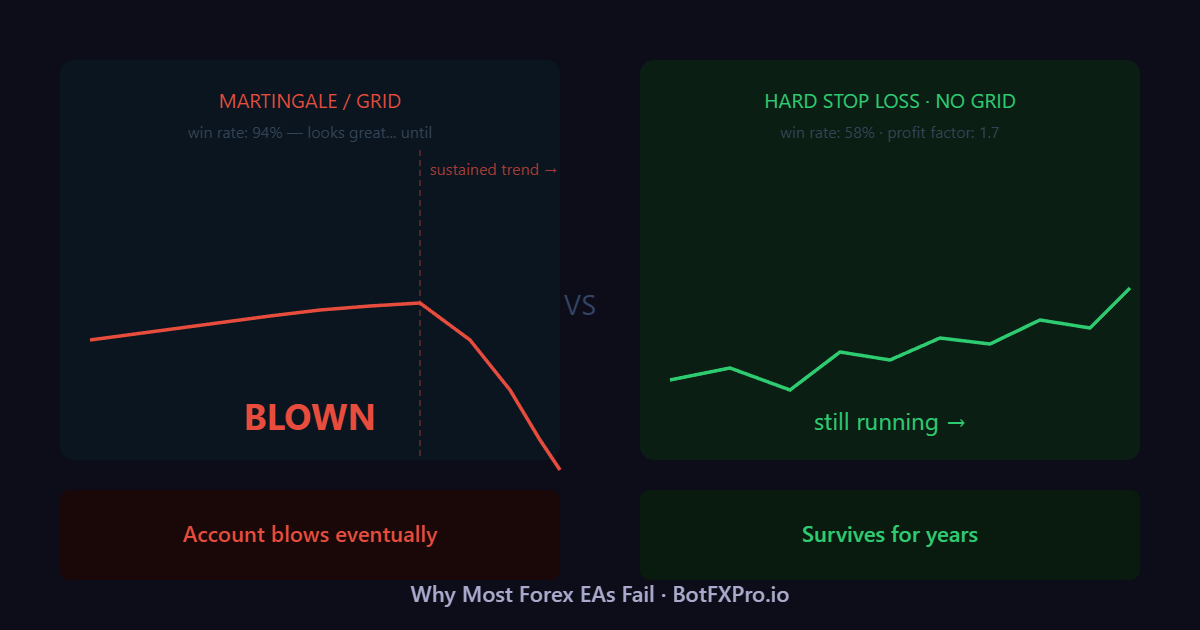
Without a stop loss, a losing trade is never closed. Instead, it sits open — accumulating loss — while the equity curve shows a smooth upward line from closed trades. When you look at the stats, all you see are the winning positions.
This approach has many names: martingale, grid trading, averaging down, hedging with correlated positions. The mechanics differ, but the principle is the same: losses are hidden, not managed.
It works until it doesn’t. A sustained trend against the open positions triggers a margin call, and the account is gone.
Why Martingale Feels Safe (Until It Isn’t)
Martingale strategies add to losing positions. If you’re down on a trade, you open another in the same direction with a larger size. If the market reverses, the combined position closes at breakeven or better.
In a ranging market, this can work for a long time. Win rates above 90% are common because most small reversals get recovered before closing at a loss.
The problem is that trend markets — especially in currency pairs or gold — can move in one direction for weeks. At that point, martingale systems don’t recover. They compound the loss with each new addition until the account is exhausted.
The win rate looks great right up until the account blows.
What “No Martingale, No Grid” Actually Means
A forex EA that uses no martingale and no grid has a fundamentally different risk profile:
- Every trade has a hard stop loss — if the trade goes wrong, the loss is fixed and finite
- Position sizing is independent per trade — a loss on one trade doesn’t affect the size of the next
- Drawdown is bounded — the worst case is a series of losses at the defined risk per trade, not an exponential blowup
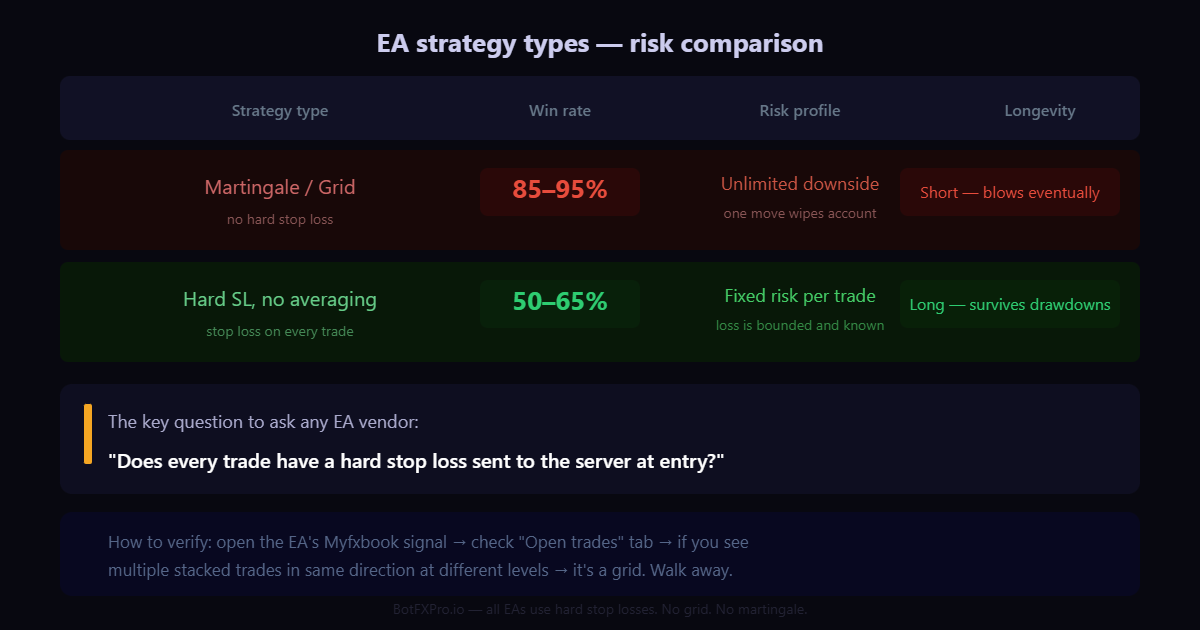
The tradeoff is that win rates tend to be lower — typically 50–65% rather than 85–95%. But a 60% win rate with a 1.5:1 reward/risk ratio is sustainably profitable. A 95% win rate with unlimited downside is not.
How to Verify a System’s Risk Approach
Before purchasing any EA, check these specific things:
1. Check the open trades section on Myfxbook
If the live signal shows multiple open trades stacked in the same direction at different price levels, it’s a grid or averaging system — regardless of what the marketing says.
2. Look at the maximum drawdown
A martingale system will show a very low drawdown until it blows. But if you look at the floating drawdown on open trades, you’ll often see large unrealized losses.
3. Ask directly
Email the vendor and ask: “Does every trade have a hard stop loss sent to the server at the time of entry?” A legitimate vendor will say yes. An evasive answer is a red flag.
4. Check the trade history
Download the full trade history from Myfxbook and look for the stop loss value on every trade. If it’s blank or zero, the system has no hard stop.
The Long-Term Advantage of Hard Stop Losses
Systems that use hard stop losses have one major structural advantage: they survive.
A martingale system that runs for 2 years might look better than a hard-stop system over the same period. But the martingale system carries the risk of a single catastrophic event that destroys everything. The hard-stop system takes smaller, defined losses and continues operating.
Over a 5–10 year horizon, the compounding effect of a consistently profitable, risk-managed system significantly outperforms a high-win-rate system that blows once every few years.
This is why institutional traders don’t use martingale. Position limits, risk per trade, and hard stops are standard practice — not because they maximize short-term performance, but because they preserve capital for the long run.
What to Look For
| Strategy Type | Win Rate | Risk Profile | Longevity |
|---|---|---|---|
| Martingale / Grid | 85–95% | Unbounded loss | Short (blows eventually) |
| Hard SL, no averaging | 50–65% | Fixed risk per trade | Long (survives drawdowns) |
When you find an EA with a multi-year live track record, hard stop losses on every trade, and no grid or martingale — that’s the rare system worth your attention.
Looking for an EA with hard stop losses, no grid, and no martingale on every trade? The Gold Trend Accelerator Combo runs 7 independent strategies on XAUUSD — each with a hard SL, zero averaging, and zero grid logic. Learn more →