Tag: Expert Advisor

  • Why Most Martingale EAs Blow Up — And What Actually Makes One Survive

    Risk Management · EA Strategy · 2026

    Why Most Martingale EAs Blow Up —
    And What Actually Makes One Survive

    BotFXPro.io · Chronos Algo · EURUSD H1 · 13+ yr backtest · 3+ yr live
    Backtest Period
    13+ Years
    Live Track Record
    3+ Years
    Max Drawdown
    32.9%
    Hard Portfolio Stop
    −65%

    The math behind why standard martingale fails is simple: without a hard stop, one extended adverse run wipes everything. The strategy assumes the market must eventually reverse — but markets can trend far longer than your margin allows.

    What’s less obvious is that the structural flaws in most martingale EAs go deeper than just “no stop loss.” After running a martingale-based EA on EURUSD H1 for over three years live and backtesting across 13+ years of data, here’s exactly what separates a system that survives from one that eventually doesn’t.

    The Core ProblemStandard martingale doubles lot size after every loss, with fixed-distance entries regardless of market structure. No edge on entry. No cap on exposure. No exit when things go truly wrong. It’s not a strategy — it’s a slow-motion account transfer.

    What a Surviving System Actually Does

    01 / 06

    NOT Pure Martingale — Adaptive Lot Multiplier

    Classic martingale doubles immediately: order 1 at 0.01, order 2 at 0.02, order 3 at 0.04. Exposure compounds fast. The second order in a structured recovery sequence, by contrast, opens at the same lot size as the first — not doubled. Only as more orders accumulate does the multiplier gradually increase.

    More importantly, if open recovery orders exceed a threshold, the system automatically reduces the multiplier. This is the opposite of what classic martingale does at exactly the wrong moment. The exposure curve flattens instead of accelerating.

    Lot size per order: Classic Martingale vs. Adaptive (relative to initial lot = 1×, max scale = 128×)
    Classic · Order 1
    Classic · Order 2
    Classic · Order 3
    Classic · Order 4
    Classic · Order 5
    16×
    Classic · Order 6
    32×
    Classic · Order 7
    64×
    Classic · Order 8
    128×

    Adaptive · Order 1
    Adaptive · Order 2
    Adaptive · Order 3
    Adaptive · Order 4
    Adaptive · Order 5
    Adaptive · Order 6
    12×
    Adaptive · Order 7
    18×
    Adaptive · Order 8
    27×

    The practical difference is significant. In a 5-order worst-case sequence, classic martingale has accumulated 16× the initial lot size by order 5. The adaptive approach reaches only 8× by order 5, then scales gradually to 12×, 18×, and 27× for orders 6–8 — versus classic martingale which would reach 32×, 64×, 128×. Same number of recovery orders: dramatically different peak exposure per order.


    02 / 06

    Every Entry Has a Real Edge — Not Random Grid Spacing

    Most martingale systems place recovery orders at fixed pip intervals regardless of what price is doing — 20 pips down, 40 pips down, 60 pips down — with no reference to market structure whatsoever.

    A properly structured system applies the same entry logic to recovery orders as to initial orders. Each position in a recovery sequence is filtered against market conditions to identify higher-probability reversal zones rather than arbitrary price levels. The result: fewer orders needed per cycle, better average entry prices, and faster recovery.

    Why this mattersRecovery speed is everything in a martingale system. A cycle that closes in 3 orders under a structured approach might take 6–7 orders under random grid spacing for the same price move. Fewer orders = lower peak exposure on every single trade. This is also what enables the adaptive multiplier to work — you can afford to start recovery orders at 1× because intelligent entry selection does part of the work that brute-force lot scaling would otherwise require.


    03 / 06

    Exposure Per Cycle Is Hard-Capped

    If a system can open unlimited orders in a single recovery sequence, it will eventually meet market conditions that exhaust your capital before it exhausts the losing streak. The question isn’t whether this happens — it’s when.

    A hard cap on orders per cycle changes the risk profile fundamentally. The worst-case scenario is calculable before you deploy real money. You can answer the question: “If every recovery order in this cycle closes at a loss, what is my maximum drawdown?” — and get an actual number, not a range that extends to account wipeout.

    Feature Standard Martingale Hard-Capped System
    Max orders per cycle Unlimited Fixed (e.g., 8)
    Worst-case calculable? No Yes — before live trading
    Capital requirement Undefined Specific and plannable
    Margin call risk Inevitable over time Bounded and manageable

    This one structural difference is what makes it possible to publish real drawdown numbers — no asterisk, no “results may vary up to account wipeout.” Position sizing is designed around a pre-calculated worst case, not wishful thinking about how bad things can get.


    04 / 06

    Portfolio-Level Kill Switch

    This is the single most important structural feature, and the one most often absent from retail martingale EAs. A hard stop loss enforced at the portfolio level — not per trade, not per cycle, but across the entire account — that closes all positions and halts the EA when cumulative drawdown hits a defined threshold.

    For Chronos Algo on EURUSD: that threshold is −65%. The EA has never come close to triggering it in 13+ years of backtesting or 3+ years live. But it exists, it’s enforced by code, and it converts an unlimited-risk strategy into a defined-risk strategy.

    The Key PrincipleDefined risk is manageable. Undefined risk is not. The difference isn’t the size of the number — it’s whether the number exists at all. A −65% hard stop is still a large loss. But a trader who knows their maximum downside can make rational capital allocation decisions. A trader with no stop cannot.

    Most EA vendors omit this because it forces them to publish a real worst-case figure. Publishing that number feels like marketing suicide. In reality, it’s the opposite — it’s the only thing that makes the risk profile honest.

    Two More Differences Nobody Talks About

    05 / 06

    The Backtest Trap — Why 10-Year Results Can Still Lie

    Backtests are easy to fabricate — not through dishonesty, but through the mechanics of how they work. Martingale EAs are particularly susceptible because the parameters controlling recovery behavior (lot multiplier, grid distance, max orders) have enormous impact on results and are easy to over-optimize.

    Run the same martingale EA with 20 different parameter sets, pick the one that looks best, and publish those results. You’ve found a set that happened to fit the past 10 years of data. You haven’t found a system that’s robust to the next 10.

    What Actually Signals RobustnessConsistent behavior across multiple market regimes — trending years, ranging years, high-volatility and low-volatility periods. Not a smooth equity curve optimized to look perfect. Drawdown periods should be visible, not suspiciously absent. Results on a live account that started years ago should roughly match the backtest shape — not significantly outperform it.

    The Chronos Algo backtest covers 2013–present, including the 2014–2015 EUR collapse, 2020 COVID volatility spike, and 2022 rate-shock trending conditions. The live account has been running since 2022 — independently verified via MQL5 Signals and Myfxbook — and the equity curve shape across those conditions matches the backtest profile. That match is what matters, not the peak return figure.


    06 / 06

    What Transparency Actually Looks Like in EA Marketing

    Almost every EA listing leads with a return percentage. Some lead with “verified results.” Almost none lead with maximum drawdown, honest strategy labeling, or a clear explanation of how the system loses money.

    The pattern is predictable: screenshot of equity curve → impressive return % → vague mentions of “smart” or “adaptive” logic → no discussion of downside. The user is expected to assume the system is low-risk because the presentation avoids discussing risk.

    What Most EAs Show What You Should Demand
    Return % only Max drawdown — actual historical peak-to-trough
    “Non-martingale” or “safe grid” Explicit strategy labeling: martingale? grid? hedging?
    Backtest screenshots only Live account on Myfxbook or MQL5 Signals
    30–90 day live track record Multi-year live results across different market regimes
    No discussion of worst case Hard stop defined, worst case calculable before you deposit

    Transparency isn’t a marketing angle — it’s what lets a serious trader make an informed decision. If a vendor can’t tell you the maximum historical drawdown, what happens when the worst recovery cycle occurs, or exactly how the system exits losing positions, that’s not a gap in the pitch deck — it’s a gap in the risk management.

    The Bottom Line

    Martingale isn’t inherently fatal. The strategies that fail aren’t failing because they use martingale — they’re failing because they stack unlimited exposure on top of no-edge entries with no emergency exit and optimistic backtests that hide the downside.

    What survives: adaptive exposure that doesn’t compound at the worst moment, entry logic that creates real edge on every order, hard caps that make worst-case scenarios calculable, and a portfolio kill switch that converts unlimited risk into defined risk.

    The live numbers for Chronos Algo on EURUSD H1: ≈32.9% max drawdown over 3+ years, hard stop at −65%, results independently verified. That’s not impressive on a return leaderboard. It’s honest — and that’s the point.

    Chronos Algo — EURUSD H1

    13+ years backtested. 3+ years live. Max drawdown ≈32.9%. Independently verified on MQL5 Signals and Myfxbook.

    View Chronos Algo →
    Live Signal ↗

    Risk disclosure: Trading forex with automated systems involves significant risk of loss. Past performance, including backtested results, does not guarantee future results. Maximum drawdown of 32.9% observed in live trading. Hard portfolio stop at −65%. Only trade with capital you can afford to lose.
    Related Reading
    Risk Management

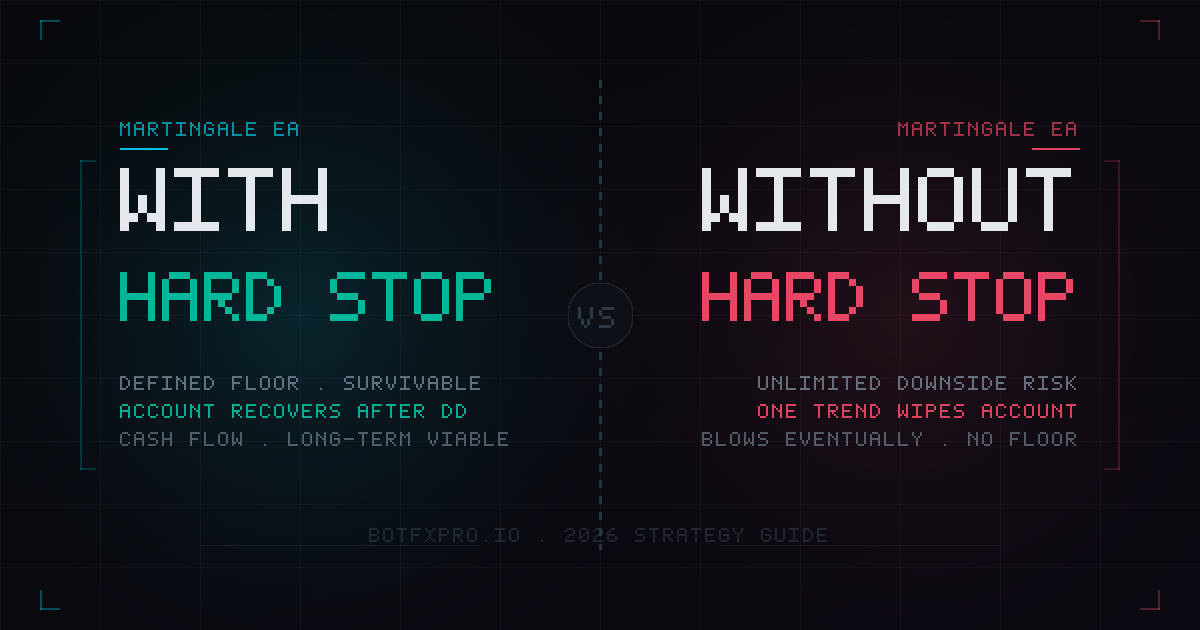
    Martingale EA With a Hard Stop vs Without: A Deep Dive for Serious Traders

    EA Reviews

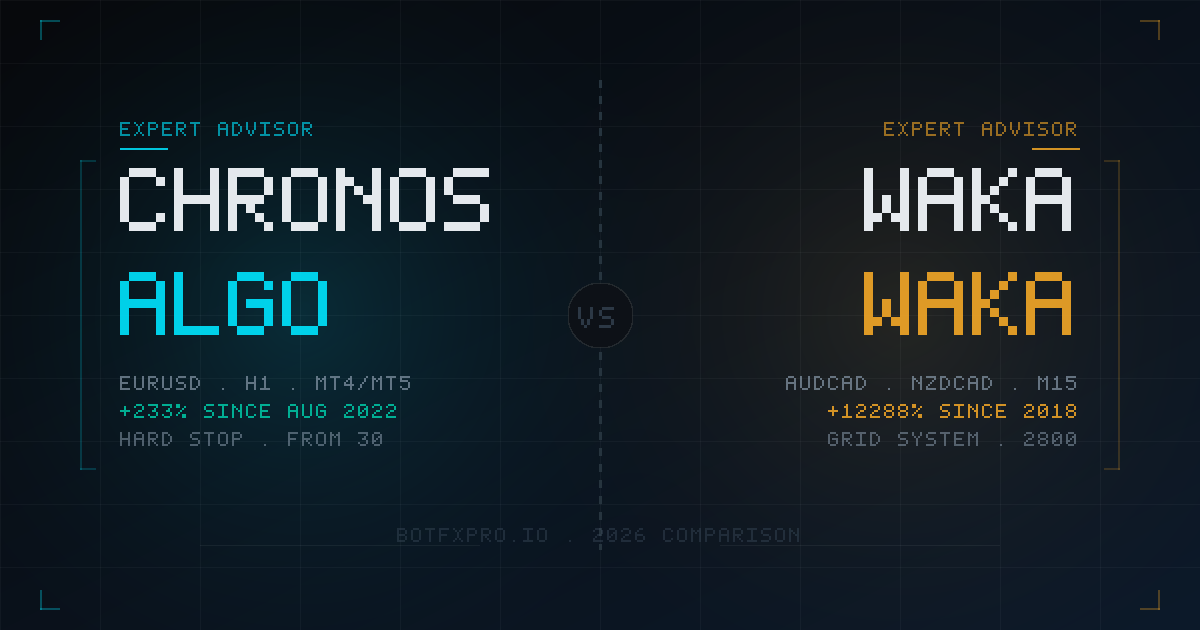
    Chronos Algo vs Waka Waka (2026): A Straightforward Comparison

  • Martingale EA With a Hard Stop vs Without: A Deep Dive for Serious Traders

    Martingale EA With a Hard Stop vs Without: A Deep Dive for Serious Traders

    EA Strategy · Risk Management · 2026

    Martingale EA With a Hard Stop vs Without:
    A Deep Dive for Serious Traders

    botfxpro.io · Martingale risk structure · Hard stop loss · Cash flow strategy

    If you’ve spent any time evaluating automated trading systems, you’ve encountered martingale. It’s one of the most polarizing strategies in retail forex — equally loved for its consistent short-term performance and feared for its catastrophic failure modes.

    The debate around martingale usually focuses on the wrong things: win rate, monthly return, drawdown percentage. These metrics matter, but they don’t answer the most important structural question.

    Does the system have a hard portfolio stop loss — and what happens when it triggers?

    That single design decision creates a fundamental divide between two types of martingale EA. They can look nearly identical for months or years. Then, when an adverse market event arrives, one survives and one doesn’t. This article explains why — mechanically, mathematically, and practically.


    How Martingale Actually Works: The Full Mechanics

    Martingale originated as a gambling strategy. In forex trading, it translates into a position averaging system. When the market moves against the initial trade, the EA opens additional positions in the same direction with progressively larger lot sizes. When the market reverses and reaches the basket’s profit target, all positions close simultaneously at a net profit.

    The mechanics create three distinctive characteristics:

    • High win rate: Because most short-term adverse moves eventually reverse, the basket closes profitably the majority of the time. Win rates of 80–95% are common. This is real — not marketing.
    • Asymmetric loss exposure: The losses that do occur are disproportionate. A single losing sequence can be 5×, 10×, or 20× the size of a typical winning trade. Win rate looks excellent right up until a deep losing sequence overwhelms the account.
    • Correlation with market regime: Martingale performs well in ranging or mean-reverting conditions. It struggles severely in trending markets — particularly strong, sustained directional moves that don’t reverse before the basket grows too large.

    The Mathematics of Position Scaling

    A typical martingale EA doubles lot size with each additional position. Starting at 0.01 lots on a $1,000 account:

    Position Lot size Cumulative exposure Relative to initial
    1 (initial) 0.01 0.01
    2 0.02 0.03
    3 0.04 0.07
    4 0.08 0.15 15×
    5 0.16 0.31 31×
    6 0.32 0.63 63×
    7 0.64 1.27 127×
    8 1.28 2.55 255×

    By position 8, cumulative lot exposure is 255 times the initial position. This is the core danger: exposure grows geometrically while account balance grows linearly. A system with no ceiling on this process will eventually hit a market condition where geometric growth outpaces the account. Without a hard stop, the result is a margin call.

    What a Hard Portfolio Stop Loss Actually Does

    A hard portfolio stop loss places a ceiling on this geometric exposure. It defines, in advance, the maximum floating loss the system will tolerate before force-closing all positions.

    Critically, this stop operates at the portfolio level, not the individual trade level. It monitors the combined floating loss of all open positions simultaneously. When total floating loss reaches the defined threshold — expressed as a percentage of account equity — every open position closes at once.

      Martingale without hard stop Martingale with hard stop
    Monthly performance Similar Similar
    Win rate 80–95% 80–95%
    Worst case Account wipeout (-100%) Defined loss (e.g. -60 to -65%)
    Account survival Not guaranteed Guaranteed floor
    Resumable after drawdown No — account gone Yes — trading continues

    The monthly returns are comparable. The difference is entirely in what happens when things go wrong. It converts unlimited risk into defined risk, removes the margin call scenario, and forces the system to be honest about its actual risk profile.


    All Three BotFXPro Martingale EAs Have Hard Stops

    Every martingale EA on BotFXPro carries a hard portfolio stop loss. This is not optional or configurable — it’s a structural requirement.

    Chronos Algo

    EURUSD · H1 · MT4 + MT5

    Entry filtered by 7-indicator confluence (Stochastic, ADX, MACD, RSI, CCI, ATR, Envelopes). Reduces trade frequency and limits sequences that reach deep recovery stages.

    Live since August 2022 — 3+ years continuous. Verified withdrawals on MQL5. Hard stop never triggered in 12+ years of backtesting or live trading.

    • Hard portfolio stop: -65%

    Velocity & Sentinel MT5

    USDCAD + AUDCAD · M15 · MT5

    Two independent martingale systems running in parallel on deliberately low-correlation pairs. When USDCAD is in a drawdown sequence, AUDCAD is statistically unlikely to be in simultaneous deep drawdown.

    The cross-pair design provides an additional layer of portfolio diversification beyond the hard stop itself.

    • Hard portfolio stop: per system

    QuantLot Expert

    EURUSD · M15 · MT5

    Hard portfolio stop at -60% with an additional cap of 8 recovery positions maximum. The position cap limits not just the loss floor but the exposure path that leads to it.

    Unlike uncapped systems where position 15–20 is theoretically possible, exposure profile is fully defined by position 8.

    • Hard portfolio stop: -60% · Max 8 positions


    Why Backtest Quality Separates Serious Systems from Marketing Tools

    Most retail EA vendors include a backtest. Very few use one that actually means anything.

    The standard approach uses interpolated tick data — approximated price points that don’t reflect actual bid/ask spread behavior, requotes, or micro-volatility that real trading produces. This type of backtest can be generated in minutes, tuned to produce exceptional results, and presented as evidence of robustness. It isn’t.

    The difference between a marketing backtest and a genuine one comes down to two variables: data quality and time horizon.

    100% Real Tick Data

    MetaTrader’s Strategy Tester offers three data quality options. Most published backtests use interpolated data because it runs faster and typically produces better-looking results.

    Real tick data uses the actual historical tick-by-tick price feed — every price update the broker received during the test period. For a martingale system, this matters enormously. Martingale baskets are sensitive to short-term price behavior. Interpolated data smooths out spread widening during news events, volatility spikes at session opens, and real pip-by-pip movement during sustained trends. Real tick data doesn’t.

    A backtest run at 100% real tick data quality cannot be gamed by smoothing. Either the system handled those market conditions or it didn’t. All BotFXPro EA backtests are run at 100% real tick data quality.

    10+ Years of Test History

    Martingale systems have a specific testing vulnerability: a short backtest can look excellent simply by avoiding the market conditions that would stress the system most. A 2-year backtest covering a calm, ranging period will produce impressive statistics. The same system run over 10–12 years will encounter multiple major trend events, currency crises, central bank interventions, and regime changes.

    Chronos Algo has been backtested over 2013–2024 — a 12-year period that includes:

    • The EUR/USD collapse of 2014–2015 (1,000+ pip sustained move)
    • Brexit volatility in 2016
    • COVID-related currency dislocations in 2020
    • The sharp USD strengthening cycle of 2022

    The -65% portfolio stop was not triggered once across any of these events. Maximum equity drawdown reached 32.40% — closely matching the live account’s ~33% recorded drawdown.

    Backtest–Live Alignment: The Real Credibility Signal

    The most meaningful backtest validation isn’t the backtest statistics themselves — it’s whether the live account behaves consistently with the backtest. A system fitted to historical data typically performs differently in live conditions. Parameters were optimized for past market structure, and when conditions change, the edge degrades. This is overfitting, and it’s the reason most EAs underperform their backtests significantly in live deployment.

    Chronos Algo: Backtest vs Live Comparison

    Backtest max equity drawdown (2013–2024): 32.40%

    Live recorded max drawdown (Aug 2022–present): ~33%

    This alignment — across a 3+ year live period including multiple market cycles — indicates the system’s logic reflects genuine market behavior, not historical curve-fitting. The -65% hard stop was calibrated on a backtest that accurately reflected real market conditions, which gives the floor genuine meaning rather than being an arbitrary number.


    Martingale as a Monthly Cash Flow Engine

    When managed correctly, a hard-stop martingale system has a specific financial advantage that few trading strategies can match: consistent monthly cash flow.

    Because win rate is high and most baskets close profitably, the account grows in a relatively predictable pattern month over month. Chronos Algo has averaged approximately ~3% per month (simple average, Myfxbook) — or roughly ~5% compounded for accounts that reinvest without withdrawals.

    This consistency makes hard-stop martingale EAs well-suited to a specific financial strategy: use the EA as a cash flow asset, not a pure growth investment.

    The Capital Recovery Framework — $10,000 Example

    Phase 1 — Compounding (approx. months 1–28)
    At ~3% per month compounded, a $10,000 account reaches approximately $20,000 in roughly 24–28 months. At that point, withdraw $10,000 — the original deposit. The remaining $10,000 continues running.

    Phase 2 — Free cash flow (month 29 onward)
    With $10,000 running at ~3% monthly average, the account generates approximately $300 per month on a position where your original capital has been fully returned.

    Withdrawal frequency Accumulated before withdrawal Approximate amount
    Monthly $300 $300
    Quarterly ~$950 (with compounding) ~$950
    Semi-annually ~$2,000 ~$2,000
    Annually ~$4,300 (at 3% compounded) ~$4,300

    Leaving profits to compound between withdrawals accelerates growth of the base. By the semi-annual mark, the base has grown to ~$11,600, so the 6-month withdrawal exceeds a simple 6× monthly figure.

    What “Zero Net Cost” Actually Means

    Once you’ve withdrawn your original $10,000, the EA continues running on profit balance. The hard stop still exists — a -65% drawdown event would reduce the profit balance significantly — but the capital at risk is no longer money you originally invested. You’ve restructured the risk: from “money I need to protect” to “gains I can afford to risk further.” This doesn’t eliminate risk. It restructures it into a form that’s psychologically and financially much easier to manage.

    Early Withdrawal: A Valid Alternative Strategy

    The framework above assumes full compounding during Phase 1. But there’s a legitimate alternative: withdraw profits frequently from the start to reduce portfolio risk progressively.

    This is the approach the Chronos Algo live account has used. Rather than compounding aggressively toward capital recovery, withdrawals were made regularly in the early months — $1,273.25 in total verified withdrawals from an initial $1,000 deposit over 3+ years. Capital recovery takes longer, but the live account balance at risk decreases steadily from the start.

    Strategy Best for
    Compound fully, then withdraw capital in one event Traders who can tolerate sustained exposure while targeting full capital recovery
    Withdraw regularly from the start Traders who want to reduce capital at risk progressively, or need current income
    Hybrid — withdraw partial profits, leave remainder to compound Traders who want a balance of current income and base growth

    How to Verify Whether a System Has a Real Hard Stop

    Before purchasing any martingale EA, verify the hard stop independently rather than taking the vendor’s word for it.

    • Check the trade history on Myfxbook. Download the full trade history and look for the SL (stop loss) field. For a basket-level hard stop, individual trades may show no per-trade stop — that’s normal. Look for documentation of the portfolio-level trigger mechanism and threshold.
    • Look at signal page comments and history. If the system has gone through a significant drawdown event, signal comments will usually show community discussion. Look for events where the portfolio stop triggered — this confirms the mechanism is real and actually fires under live conditions.
    • Ask the vendor directly: “At what portfolio drawdown percentage do all open positions force-close? Is this handled by a server-side stop or by EA logic on the client terminal?” A vendor with a genuine hard stop answers this immediately and specifically. Vague answers about “risk management features” are a red flag.
    The Question to Ask Any Martingale EA Vendor

    “Does every trade have a hard stop loss defined at entry? At what portfolio drawdown percentage are all positions force-closed?”

    If the answer is specific and documented, that’s a system worth evaluating. If the answer is vague — or if the trade history shows no stop loss values — that system carries unlimited downside risk regardless of how good the historical performance looks.

    See All Three BotFXPro Hard-Stop Martingale EAs

    Chronos Algo, Velocity & Sentinel MT5, and QuantLot Expert — each with a defined hard portfolio stop and 100% real tick backtests.

    View All EAs →

    Risk Disclosure: All martingale EAs described carry substantial risk of loss. Hard stop losses limit but do not eliminate loss — a -60% or -65% drawdown event results in significant reduction of account value. Past performance including verified live records and backtest results does not guarantee future results. The “zero net cost” cash flow framework described assumes the EA continues to perform at historical averages, which cannot be guaranteed. All trading of leveraged instruments may not be suitable for all investors. This article is for informational purposes only and does not constitute financial advice.
  • Chronos Algo vs Waka Waka (2026): A Straightforward Comparison for Serious Traders

    Chronos Algo vs Waka Waka (2026): A Straightforward Comparison for Serious Traders

    Expert Advisor Comparison · 2026

    Chronos Algo vs Waka Waka
    A Straightforward Comparison for Serious Traders

    botfxpro.io · EURUSD / AUD-NZD crosses · Martingale basket systems · Verified live records

    Waka Waka is one of the most recognized Expert Advisors on the MQL5 marketplace — with a live track record stretching back to 2018, verified on Myfxbook, and thousands of copies sold. Chronos Algo is a more recent EA from BotFXPro, live since August 2022, trading EURUSD on the H1 timeframe.

    Both are martingale basket systems. Both have multi-year verified live records. But beyond that surface similarity, the two EAs differ significantly in strategy design, pairs traded, drawdown behavior, transparency — and price.

    This article is a direct comparison. No marketing language. Just the numbers and the trade-offs that matter when deciding where to put real capital.


    At a Glance

    Chronos Algo

    • EURUSD · H1 · MT4 + MT5
    • Martingale basket strategy
    • Hard portfolio stop at -65%
    • 3+ years live · Myfxbook verified
    • +233% gain since Aug 2022
    • From $30 · lifetime license

    Waka Waka

    • AUDCAD, AUDNZD, NZDCAD · M15
    • Grid + martingale strategy
    • No fixed hard portfolio stop
    • 7+ years live · Myfxbook verified
    • +12,000%+ since Jun 2018 (signal)
    • $2,800 · lifetime license

    Strategy: How Each EA Actually Trades

    Chronos Algo — Martingale Basket on EURUSD H1

    Chronos Algo trades EURUSD on the 1-hour chart using a multi-indicator entry filter that requires agreement across Stochastic, ADX, MACD, RSI, CCI, ATR, and Envelopes before opening a position. This deliberate filtering reduces how often the EA enters the market, limiting the frequency of recovery sequences.

    When the market moves against the initial position, the EA opens additional positions in the same direction with progressively larger lot sizes — a martingale basket. Exit logic is tiered: small baskets close at a profit target; larger baskets shift to breakeven exit, closing all positions the moment equity recovers to entry level.

    A hard portfolio stop loss at -65% closes all open positions automatically if account drawdown reaches that threshold. The -65% floor defines the absolute worst-case outcome.

    Waka Waka — Grid System on AUD/NZD Crosses

    Waka Waka trades AUDCAD, AUDNZD, and NZDCAD on the M15 timeframe. These cross pairs were chosen for their tendency to range rather than trend aggressively, which suits grid-style recovery logic. The EA uses ML-based pattern recognition as an entry filter and opens additional positions at regular grid intervals when the market moves against the initial trade.

    The developer describes the system as an “advanced grid system” rather than pure martingale, as lot sizes don’t always double. Risk is managed through position sizing controls rather than a fixed stop loss, meaning the EA can theoretically hold open positions indefinitely if the market trends strongly against it.

    The Core Risk of Both Systems

    Both Chronos Algo and Waka Waka share the same fundamental characteristic: they add to losing positions. In ranging or mean-reverting conditions, this works well. In sustained trending conditions — particularly sharp, one-directional moves — both systems can accumulate significant floating loss before recovering. Understanding this is essential before using either EA with real capital.


    Risk Structure: Side by Side

    Factor Chronos Algo Waka Waka
    Core strategy Martingale basket · trend entries Grid + martingale · ranging pairs
    Martingale Yes — core, fully disclosed Yes — grid spacing, configurable
    Per-trade stop No — basket managed as unit No — position sizing controls
    Portfolio hard stop Yes — closes all at -65% No fixed hard stop (configurable)
    Max drawdown (live) ~33% (Myfxbook verified) ~66% (signal account)
    Worst-case outcome -65% (system closes at this floor) Theoretically -100% without risk limits
    Pairs traded EURUSD only AUDCAD, AUDNZD, NZDCAD
    Timeframe H1 M15
    Platforms MT4 + MT5 MT4 + MT5

    The most significant structural difference is the hard portfolio stop loss. Chronos Algo will automatically close all positions if floating loss reaches -65% of equity — defining the worst-case outcome before you start trading. Waka Waka does not have an equivalent fixed floor in its default configuration.


    Live Track Records

    Chronos Algo

    Cumulative Gain
    +233%
    Since Aug 2022 · MT4 live
    Max Drawdown
    ~33%
    Live recorded · hard floor -65%
    Verified Withdrawals
    $1,273
    Verified on MQL5
    Live Since
    Aug ’22
    3+ years continuous

    Chronos Algo has been running on a live MT4 account since August 2022 with the same initial $1,000 deposit and no additional capital injections. Gains have been periodically withdrawn — $1,273.25 in verified MQL5 withdrawals as of 2026. An MT5 account was added in 2025 as a parallel live track record.

    Waka Waka

    Cumulative Gain
    +12,288%
    Since Jun 2018 · signal account
    Max Drawdown
    ~66%
    Signal account recorded
    Abs. Gain
    +458%
    On total deposited capital
    Live Since
    Jun ’18
    7+ years continuous

    Waka Waka’s signal account (MischenkoValeria on MQL5) has been running since June 2018 — a genuinely long live record. Total deposits of $3,500 against withdrawals of $4,352 mean capital has been added at certain points in its history, which is important context when interpreting the cumulative gain percentage. Absolute gain on total deposited capital is approximately +458%.

    A Note on Martingale Track Records

    One inherent challenge when evaluating martingale-based EAs: the developer’s own account — which serves as the primary marketing asset — is managed with more flexibility than a typical user’s account. When markets trend strongly against open positions, a developer can choose to add capital, reduce risk settings, or close positions manually to prevent a reset. User accounts running default settings don’t have the same backstop.

    This doesn’t mean the track record is invalid — but it’s a meaningful difference between what you see on the signal page and what your account will experience.


    Monthly Returns & Value Comparison

    Metric Chronos Algo Waka Waka (signal)
    Avg monthly gain ~3% simple (Myfxbook) · ~5% compounded ~5.2% (stated monthly, signal)
    Profitable months ~80% of months since Aug 2022 70+ consecutive profitable months (claim)
    Worst single month Drawdown periods, no forced reset -84% recorded in one user account (May 2024)
    License price From $30 (per account, lifetime) $2,800 (lifetime)

    Chronos Algo averages approximately ~3% per month on a simple basis according to Myfxbook. For accounts that reinvest returns without withdrawals, the compound monthly rate works out to roughly ~5% — comparable to Waka Waka’s stated ~5.2%. The break-even analysis below uses the conservative 3% simple figure.

    Break-Even Analysis — $1,000 Account, ~3% Monthly

    Chronos Algo ($30 starter): License recovered in 1 month. Net profit begins almost immediately.

    Waka Waka ($2,800): License cost requires ~93 months of Chronos-equivalent returns to break even — before accounting for any drawdown periods.

    For larger accounts ($10,000+), the proportional impact of the license cost decreases significantly for Waka Waka. At that scale, the decision shifts to track record depth and strategy preference.


    Which EA Fits Which Trader?

    You want a defined worst-case loss before you buy Chronos Algo — the -65% hard stop defines the maximum outcome
    You prefer AUD/NZD pairs and M15 timeframe Waka Waka — optimized specifically for those cross pairs
    Starting with limited capital ($500–$2,000) Chronos Algo — $30 license, $1,000 minimum recommended capital
    You value the longest possible live track record Waka Waka — 7+ years live, genuine market cycle history since 2018
    Running multiple accounts Chronos Algo — per-account pricing from $30 scales efficiently
    You want verified withdrawals from the live account Chronos Algo — $1,273.25 in verified MQL5 withdrawals
    You have $5,000+ and want a well-known system Either — evaluate strategy fit and drawdown tolerance at that capital level

    Final Verdict

    Waka Waka is a legitimate, well-established EA with a longer track record than almost anything else in the retail market. Its 7+ years of verified live performance is genuinely unusual. If you’re choosing based on track record depth alone, Waka Waka has the edge.

    Chronos Algo is newer, trades a single pair, and lacks the decade-long history. But what it offers in exchange is a clearly defined risk structure — a hard -65% portfolio stop that removes the ambiguity of open-ended drawdown — combined with a price point that makes it accessible to traders with modest capital.

    For traders primarily concerned with understanding exactly what can go wrong before they start, Chronos Algo’s transparent risk floor is a genuine differentiator. For traders with larger accounts who want the longest possible verified history and are comfortable managing grid-based risk exposure, Waka Waka remains a credible option — provided capital is sized appropriately.

    Neither system eliminates the fundamental risk of martingale and grid trading. Both can produce significant drawdowns in sustained trending conditions. That risk is built into the strategy — and is true of any EA in this category.

    See Chronos Algo’s Full Live Track Record

    3+ years live. Verified withdrawals on MQL5. Hard portfolio stop at -65%. From $30 lifetime.

    View Chronos Algo →

    Risk Disclosure: Both Chronos Algo and Waka Waka are martingale/grid-based systems. They can open multiple positions with progressively larger lot sizes during adverse market conditions. Past performance does not guarantee future results. The -65% hard stop loss in Chronos Algo limits but does not eliminate loss. All trading of leveraged instruments carries substantial risk of loss and may not be suitable for all investors. This article is for informational purposes only and does not constitute financial advice.
  • Chronos Algo vs Forex Fury (2026): A Straightforward Comparison for Serious Traders

    Chronos Algo vs Forex Fury (2026): A Straightforward Comparison for Serious Traders

    Chronos Algo and Forex Fury are both long-running Expert Advisors with verified live accounts, real user bases, and genuine track records. They are also fundamentally different in how they trade, how they manage risk, and what kind of trader each one suits.

    This comparison covers both EAs honestly — including the risks of each. The goal is to give you the information to make a decision that fits your account size, risk tolerance, and trading goals.


    At a Glance

    Chronos Algo

    • EURUSD · H1 · MT4 + MT5
    • Martingale basket strategy
    • Hard portfolio stop at -65%
    • 3+ years live · Myfxbook verified
    • +233% gain since Aug 2022
    • From $30 · lifetime license

    Forex Fury

    • Multi-pair · MT4 + MT5
    • Range scalping strategy
    • Optional martingale feature
    • Multi-year live · Myfxbook verified
    • 93% claimed win rate
    • $250 · lifetime license


    Strategy: How Each EA Actually Trades

    Chronos Algo — Martingale Basket on EURUSD H1

    Chronos Algo trades EURUSD on the 1-hour chart using a multi-indicator entry filter that requires agreement across Stochastic, ADX, MACD, RSI, CCI, ATR, and Envelopes before opening a position. This deliberate filtering reduces how often the EA enters the market, which limits the frequency of recovery sequences.

    When the market moves against the initial position, the EA opens additional positions in the same direction with progressively larger lot sizes — a martingale basket. Exit logic is tiered: small baskets close at a profit target; larger baskets shift to breakeven exit, closing all positions the moment equity recovers to entry level. This prevents deep sequences from requiring a large profit recovery before closing.

    A hard portfolio stop loss at -65% closes all open positions automatically if account drawdown reaches that threshold. Individual trades carry no per-trade stop — the system manages positions as a basket. The -65% floor defines the absolute worst-case outcome.

    What this means for your account

    On a $1,000 account, the absolute worst-case single loss is $650 — if the -65% hard stop triggers. In practice, the maximum recorded drawdown on the live account is -32.90%, meaning this floor has not been approached in 3+ years of real trading.

    This is also consistent with the backtest record. Across 11 years of backtesting (2013–2024) using 100% real tick data with the same default settings used on the live account, the maximum equity drawdown reached 32.40% — and the -65% portfolio stop was never triggered across the entire period. The close alignment between backtest drawdown (~32%) and live drawdown (~33%) suggests the strategy behaves as expected in real market conditions. Minimum recommended capital is $1,000.

    Forex Fury — Range Scalping During Low-Volatility Windows

    Forex Fury targets brief periods of low market volatility — typically around 4–5 PM EST — and trades within defined price ranges, aiming for small, consistent 5-pip take profits. This narrow targeting approach produces a high win rate (claimed 93%, independently cited as ~91%) by avoiding the volatility of major sessions and news events.

    The EA trades one currency pair per account. Default settings do not attach a stop loss to individual trades. An optional martingale feature is available, which increases lot size after a loss to accelerate recovery — but this can be disabled by the user. Risk settings (low / medium / high) adjust position sizing and exposure.

    What This Means for Your Account

    The high win rate provides strong protection in stable, ranging conditions. In trending or high-volatility markets, the absence of a per-trade stop loss means losing positions can remain open for extended periods. Managing risk settings carefully — and understanding how the martingale option affects exposure — is important before running this EA live.


    Risk Structure: Side by Side

    Factor Chronos Algo Forex Fury
    Core strategy Martingale basket · trend-following Range scalping · low-volatility sessions
    Martingale Yes — core strategy, fully disclosed Optional feature · off by default
    Per-trade stop loss No — basket managed as unit No — by default; configurable
    Portfolio hard stop Yes — closes all at -65% drawdown No published hard stop
    Win rate 77.51% (backtest) · live varies 93% claimed · ~91% independently cited
    Trade frequency Low — multi-indicator filter limits entries Daily — trades ~1 hour per day
    Pairs traded EURUSD only Multiple pairs (one per account)
    Platforms MT4 + MT5 MT4 + MT5
    Prop firm compatible Generally no — martingale restricted Varies — some settings may qualify

    Live Track Records

    Chronos Algo

    Cumulative gain
    +233%
    Since Aug 2022 · MT4 live

    Max drawdown
    32.90%
    Live recorded · hard floor -65%

    Verified withdrawals
    $1,273
    Verified on MQL5

    Live since
    2022
    3+ years continuous

    Chronos Algo has MT4 and MT5 live accounts, both independently tracked on Myfxbook. Verified withdrawals of $1,273.25 on MQL5 confirm that real profits were extracted from the account — not just reflected in an equity curve. The account has run continuously since August 2022 without restart. The backtest covers 2013–2026 with 99.9% tick data, showing a profit factor of 1.99.

    Forex Fury

    Forex Fury has published Myfxbook-verified accounts since 2015 with a claimed 93% win rate and gains exceeding 200% on select accounts. The EA has a large user base of 21,600+ clients. Live results are verifiable on Myfxbook. Performance varies based on broker, settings, and market conditions — as with all EAs, individual results may differ from the published accounts.


    Pricing

    Chronos Algo
    From $30
    Lifetime · per account

    Forex Fury
    $250
    Lifetime · single license

    Chronos Algo is priced per account with a lifetime license. Forex Fury is priced at $250 for a single account license with lifetime updates. For traders running multiple accounts, per-account pricing makes a meaningful difference in total cost.


    Which EA Fits Which Trader?

    You want a defined worst-case loss before you buy Chronos Algo — the -65% hard stop defines the maximum outcome
    You prefer a high win rate with frequent small gains Forex Fury — 91–93% win rate with daily trade activity
    You’re running multiple accounts Chronos Algo — per-account pricing from $30 scales better
    You want to trade multiple currency pairs Forex Fury — supports multiple pairs across separate accounts
    You value a long, uninterrupted live track record Both — each has multi-year verified live history
    You’re starting with limited capital ($100–$500) Forex Fury — lower minimum capital requirement
    You want to verify real withdrawals from the live account Chronos Algo — $1,273.25 in verified MQL5 withdrawals
    A note on prop firm trading

    Both EAs use strategies that may conflict with prop firm rules. Martingale-based systems (Chronos Algo) are generally prohibited by most funded account programs. Forex Fury may qualify with certain settings, but check your firm’s specific rules before using either EA on a challenge or funded account.


    Summary

    Chronos Algo and Forex Fury are built for different trading philosophies. Forex Fury is designed around high-frequency, low-risk-per-trade scalping that wins consistently in calm conditions. Chronos Algo is a trend-following martingale system that trades less frequently but captures larger moves — with a hard portfolio stop that defines the absolute downside.

    Neither EA is right for everyone. The choice comes down to what kind of risk you prefer to manage: the frequency risk of a scalper that needs stable conditions, or the drawdown risk of a martingale system with a defined floor.

    Both have verifiable live track records. Both have been running for multiple years. Both carry real risk — as all leveraged trading systems do. Whichever you choose, understanding the risk structure before you deploy capital is the most important step.

    See Chronos Algo’s Full Live Track Record

    3+ years live. Verified withdrawals on MQL5. Hard portfolio stop at -65%. From $30 lifetime.

    View Chronos Algo →

    Risk Disclosure: Chronos Algo is a Martingale-based system. It can open multiple positions with progressively larger lot sizes during adverse market conditions. A hard portfolio stop loss at -65% is enforced, but this stop can still be triggered in extreme market conditions — resulting in a loss of up to 65% of your account balance. Forex trading involves substantial risk of loss and is not suitable for all investors. Past performance is not indicative of future results. Never trade with money you cannot afford to lose. Always test on a demo account before deploying live. Minimum recommended capital: $1,000. Information on Forex Fury is sourced from publicly available materials and independent reviews; BotFXPro makes no claims regarding its performance or suitability.

  • Why Most Forex EAs Fail(And How to Find One That Doesn’t)

    Why Most Forex EAs Fail(And How to Find One That Doesn’t)

    The statistics on forex EA failure are not encouraging. Most automated trading systems stop working within 12–18 months of release. Many blow accounts within weeks of going live.

    But some systems run for years, generate real profits, and survive multiple market cycles.

    The difference usually comes down to one thing: how losses are handled.


    The Core Problem: Manufacturing a Good Track Record

    The easiest way to build a forex robot with an impressive-looking track record is to remove the stop loss.

    Without a stop loss, a losing trade is never closed. Instead, it sits open — accumulating loss — while the equity curve shows a smooth upward line from closed trades. When you look at the stats, all you see are the winning positions.

    This approach has many names: martingale, grid trading, averaging down, hedging with correlated positions. The mechanics differ, but the principle is the same: losses are hidden, not managed.

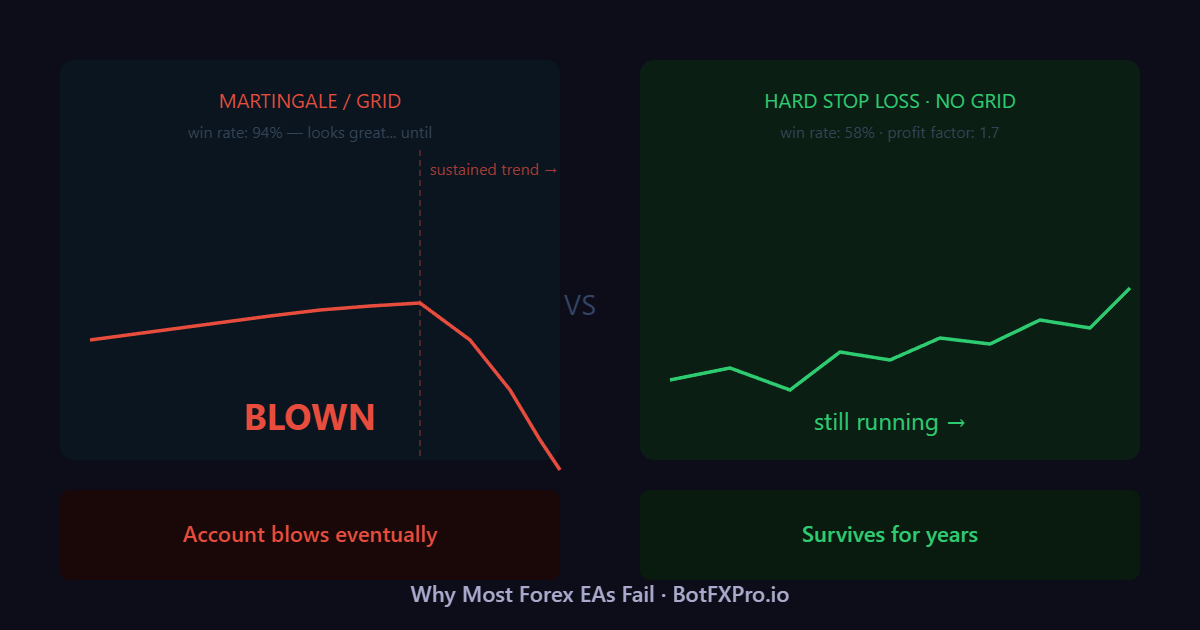
    It works until it doesn’t. A sustained trend against the open positions triggers a margin call, and the account is gone.


    Why Martingale Feels Safe (Until It Isn’t)

    Martingale strategies add to losing positions. If you’re down on a trade, you open another in the same direction with a larger size. If the market reverses, the combined position closes at breakeven or better.

    In a ranging market, this can work for a long time. Win rates above 90% are common because most small reversals get recovered before closing at a loss.

    The problem is that trend markets — especially in currency pairs or gold — can move in one direction for weeks. At that point, martingale systems don’t recover. They compound the loss with each new addition until the account is exhausted.

    The win rate looks great right up until the account blows.


    What “No Martingale, No Grid” Actually Means

    A forex EA that uses no martingale and no grid has a fundamentally different risk profile:

    • Every trade has a hard stop loss — if the trade goes wrong, the loss is fixed and finite
    • Position sizing is independent per trade — a loss on one trade doesn’t affect the size of the next
    • Drawdown is bounded — the worst case is a series of losses at the defined risk per trade, not an exponential blowup

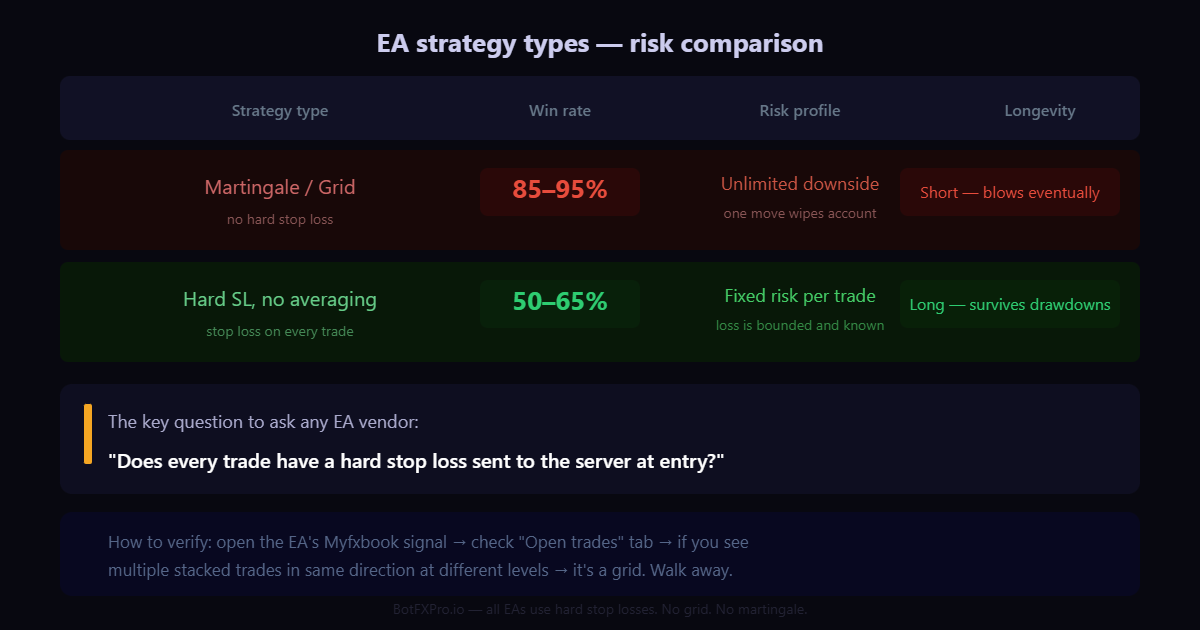
    The tradeoff is that win rates tend to be lower — typically 50–65% rather than 85–95%. But a 60% win rate with a 1.5:1 reward/risk ratio is sustainably profitable. A 95% win rate with unlimited downside is not.


    How to Verify a System’s Risk Approach

    Before purchasing any EA, check these specific things:

    1. Check the open trades section on Myfxbook

    If the live signal shows multiple open trades stacked in the same direction at different price levels, it’s a grid or averaging system — regardless of what the marketing says.

    2. Look at the maximum drawdown

    A martingale system will show a very low drawdown until it blows. But if you look at the floating drawdown on open trades, you’ll often see large unrealized losses.

    3. Ask directly

    Email the vendor and ask: “Does every trade have a hard stop loss sent to the server at the time of entry?” A legitimate vendor will say yes. An evasive answer is a red flag.

    4. Check the trade history

    Download the full trade history from Myfxbook and look for the stop loss value on every trade. If it’s blank or zero, the system has no hard stop.


    The Long-Term Advantage of Hard Stop Losses

    Systems that use hard stop losses have one major structural advantage: they survive.

    A martingale system that runs for 2 years might look better than a hard-stop system over the same period. But the martingale system carries the risk of a single catastrophic event that destroys everything. The hard-stop system takes smaller, defined losses and continues operating.

    Over a 5–10 year horizon, the compounding effect of a consistently profitable, risk-managed system significantly outperforms a high-win-rate system that blows once every few years.

    This is why institutional traders don’t use martingale. Position limits, risk per trade, and hard stops are standard practice — not because they maximize short-term performance, but because they preserve capital for the long run.


    EA strategy types — risk comparison

    What to Look For

    Strategy TypeWin RateRisk ProfileLongevity
    Martingale / Grid85–95%Unbounded lossShort (blows eventually)
    Hard SL, no averaging50–65%Fixed risk per tradeLong (survives drawdowns)

    When you find an EA with a multi-year live track record, hard stop losses on every trade, and no grid or martingale — that’s the rare system worth your attention.


    Looking for an EA with hard stop losses, no grid, and no martingale on every trade? The Gold Trend Accelerator Combo runs 7 independent strategies on XAUUSD — each with a hard SL, zero averaging, and zero grid logic. Learn more →