Education · Trade Management · 8 min read
Moving your stop loss to breakeven feels like the responsible thing to do. The trade is in profit, the worst case is now zero loss, and you can sleep at night. Every trading book repeats some version of “always protect your capital first.”
But here is what nobody mentions: aggressive breakeven moves are also one of the most common reasons traders bleed equity in trending markets. The trade you stopped out at breakeven yesterday is the same trade that ran 8R today — without you. Multiply that mistake across a year and “responsible risk management” turns into a slow drain on your equity curve.
The real skill is not knowing how to move stops to breakeven. The real skill is knowing when to move them — and when to leave them alone.
The Core Trade-Off
Every breakeven move trades drawdown protection for expected value. Move too early and you cap winners at zero. Move too late and you give back open profits. The right answer depends on your strategy, your timeframe, and what the market is actually doing right now — not on a fixed rule.
What “Breakeven” Actually Means
A breakeven stop moves your stop loss from its original level to your entry price (plus or minus a small offset to cover spread and commission). Once moved, the trade can no longer lose money — but it can no longer be a “breakeven loser” either, because the stop now sits in front of price action that would otherwise still be normal market noise.
Breakeven is almost always triggered at a multiple of your initial risk distance, expressed in R-multiples:
Entry: 1.0850 · Initial SL: 1.0820 · R = 30 pips
Trigger BE at 1R → when price hits 1.0880, move SL to 1.0850
Trigger BE at 0.5R → when price hits 1.0865, move SL to 1.0850
The trigger R is the variable that changes everything. Move at 0.5R and you protect against more drawdown, but get stopped out frequently on normal pullbacks. Move at 2R and you let trades breathe, but give back more open profit when winners reverse.
When to Move Aggressively (Early)
There are specific situations where moving to breakeven at 0.5R or 1R makes mathematical sense. They share one common feature: the strategy does not depend on catching big runners.
Scalping and short-term mean reversion
If your average winner is 1.5R and you take 5+ trades per day, you do not need any single trade to run to 5R. A 0.5R-1R breakeven move protects you from intraday reversals that would otherwise turn 70% of your “almost winners” into full losers. The cost (capping a few runners) is small relative to the benefit (preserving high win rate).
News-driven trades
When you enter on a news catalyst, the reason for the trade has a known expiration. Once price has moved 1R in your direction, the news edge is mostly priced in — anything beyond that is just market noise. Moving stops aggressively prevents you from giving back the news pop when liquidity returns to normal.
Prop firm challenges
When you are 2 winning trades away from passing FTMO Phase 1 and one losing trade away from blowing it, the math changes completely. Locking profits at 1R becomes more valuable than chasing 3R wins. The asymmetry of “pass or fail” overrides the asymmetry of “winners pay for losers.”
Quick Heuristic
If your strategy expects average winners under 2R, move stops to breakeven at 1R. If you expect winners to average 3R+, wait until 1.5R-2R before moving — or skip breakeven entirely and use a wider trailing stop.
When to Wait (or Skip Breakeven Entirely)
The opposite case — where aggressive breakeven moves actively hurt your edge — happens more often than most traders realize.
Trend-following and breakout strategies
If your strategy depends on catching the occasional 5R-10R move to make a profit (think trend following, breakout trading), moving to breakeven at 1R is statistically equivalent to throwing away your edge. The math: in trending strategies, the winners that cover all your losers are the ones that go past 3R. If you cap them at breakeven on every normal pullback, you eliminate the only trades that pay your bills.
Trend strategy: 35% win rate, average winner 4R
Without BE: 35% x 4R – 65% x 1R = +0.75R per trade
With BE@1R that triggers on 30% of winners that pull back:
Net edge collapses from +0.75R to under +0.30R per trade
Same strategy, same trades, same market — half the expected value. The breakeven move did not protect anything; it just moved the loss from “small loss on a stop-out” to “missed gain on a winner that reversed temporarily before continuing.”
Higher-timeframe swing trades
On a daily or weekly chart, “1R” might represent a multi-day move. Moving stops to breakeven the moment price hits 1R means stopping out on normal intraday volatility. Swing trades need room to breathe — typically waiting until 2R-3R before any stop adjustment, and then trailing rather than locking flat.
Strategies with edge in pullbacks
Some strategies actually expect price to retrace 30-50% before continuing. If your entry method exploits this pattern, moving to breakeven at 1R puts your stop directly in the path of normal expected behavior. You will get stopped out, then watch price continue exactly as your strategy predicted — without you in the trade.
The Offset That Most Traders Forget
When the EA or platform moves your stop “to breakeven,” it usually places it exactly at your entry price. This sounds correct, but in practice creates a hidden loss every single time it triggers.
Why? Because spread and commission still apply. A buy entry at 1.0850 with a stop at 1.0850 will close at the bid (~1.0848 with a 2-pip spread), giving you a small loss. Add commission and you might be losing $5-$15 per “breakeven” trade. Run that across 200 trades a year and your “loss-free” stops cost you $1,000-$3,000.
The fix is simple: configure breakeven to move the stop to entry plus an offset — usually 2-5 pips for Forex pairs, larger for instruments with wider spreads (gold, indices, oil). The offset covers the spread and commission, ensuring “breakeven” actually means breakeven.
Buy at 1.0850, spread 2 pips, commission $7
SL at exact entry 1.0850 → triggers at 1.0848 → -$27 net
SL at entry + 5 pip offset 1.0855 → triggers at 1.0853 → +$23 net
Multi-Level Breakeven — The Underrated Technique
The biggest leap in stop management beyond single-trigger breakeven is using multiple levels. Instead of one binary “BE on at 1R” decision, you stage protection in tiers:
- Level 1 at 1R: Move SL to entry + small offset (true breakeven).
- Level 2 at 2R: Move SL to +0.5R (lock half the original risk as profit).
- Level 3 at 3R: Move SL to +1.5R (lock 1.5x your risk regardless of what happens next).
Each level fires once and never moves backward. The result: you keep your stop wide enough to let trades breathe early, but progressively tighter as the trade matures. This is the structural setup professional traders use because it captures both runner-friendly behavior at the start and aggressive profit protection toward the end.
Practical Tip
Multi-level breakeven only works if it executes automatically and only once per level. Manual multi-level management is the fastest way to make double-modification mistakes that move stops in the wrong direction during fast moves. Always use a tool that bitmask-tracks which levels have already fired per ticket.
The “Mental Breakeven” Trap
Some traders avoid moving stops at all and instead use a “mental breakeven” — they tell themselves they will close the trade manually if price comes back to entry. This sounds disciplined. It is not.
In practice, mental breakeven fails three ways:
- You are not watching when it matters. The reversal happens during your sleep, your meeting, your lunch — the exact moment you cannot react.
- You hesitate when you are watching. Price comes back to entry and you think “let me give it a few more pips.” That is how mental breakevens become 1R losses.
- It defeats the purpose of automation. If you have to babysit the trade, you have just downgraded a position-sizing system into a discretionary trade.
If you are going to use breakeven at all, it has to be a hard stop attached to the position by the broker. Mental discipline is not the bottleneck — execution speed is.
Putting It All Together
A practical decision framework:
- Scalping or news trading? Single-level BE at 0.5R-1R with a 2-5 pip offset.
- Intraday trend following? Multi-level BE at 1R / 2R / 3R, paired with a trailing stop after level 3.
- Higher-timeframe swing? Skip BE entirely, use ATR-based trailing from 2R onward.
- Prop firm challenge phase? Aggressive BE at 1R, prioritize pass over profit maximization.
- Live funded account? Match your live BE rules to whatever you backtested. Do not “tighten up” because the money is real.
The point is: breakeven is a strategy-specific tool, not a universal best practice. Backtest it explicitly against your strategy. If turning it on improves your equity curve, use it. If turning it on flattens your big winners, leave it off.
Making It Automatic
All of the above only works if breakeven is enforced automatically. Manual breakeven management is the source of the three failure modes above — missed moves, hesitation, and accidental double-modification.
RiskFlow Pro handles single-level and multi-level breakeven automatically, with configurable trigger R, offset in pips, and per-ticket bitmask tracking so each level only fires once. The same dashboard manages partial close at progressive R-multiples, so you can stage profit protection alongside breakeven moves without any manual intervention.
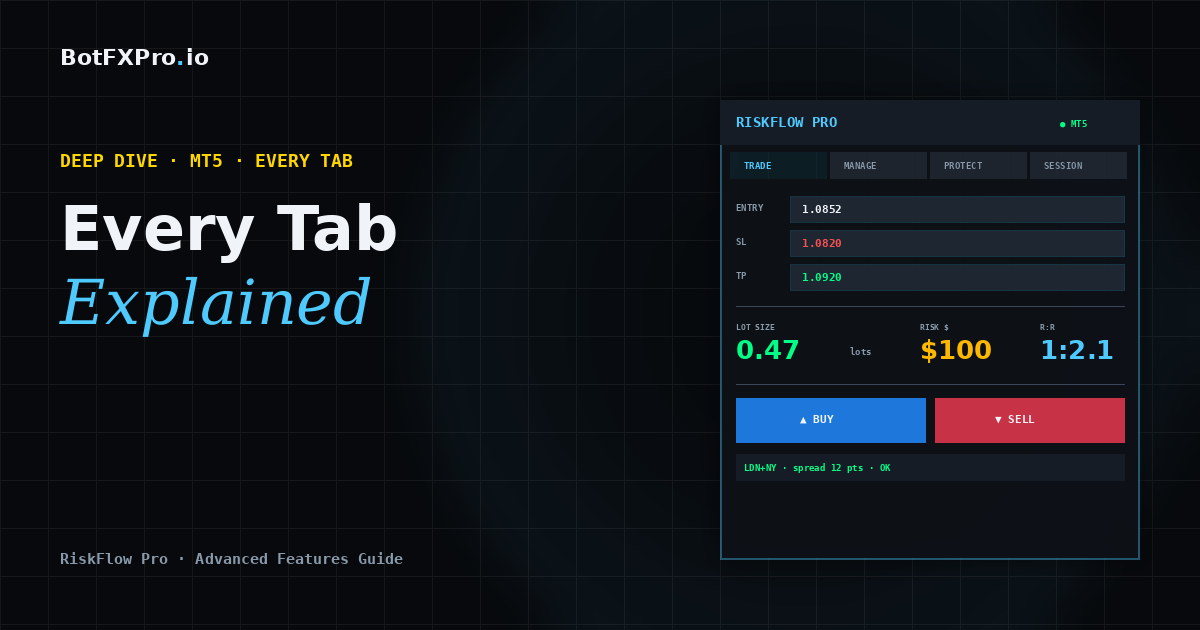
For the full breakdown of how multi-level breakeven, partial close, and ATR trailing combine in real trade scenarios — including specific FTMO setups — the Advanced Features guide walks through each combination with concrete examples on Gold, EURUSD, and US30.
Key Takeaways
- Breakeven is not free — it trades drawdown protection for expected value. The right setting depends on your strategy.
- Move early (0.5R-1R) for scalping, news trading, and prop firm challenges where capping risk matters more than catching runners.
- Move late or skip entirely for trend-following, breakout, and swing strategies where 5R+ winners pay for losers.
- Always use an offset in pips to cover spread and commission — “exact entry” breakeven is actually a small loss every time.
- Multi-level breakeven (1R, 2R, 3R) outperforms single-level for most intraday strategies — but only if executed automatically.
- Mental breakeven is not breakeven. If it is not enforced by the broker, it does not exist.
Get RiskFlow Pro
Multi-level breakeven, automatic, on every trade.
Stage your stops at 1R, 2R, 3R with configurable offsets — and pair with partial close at the same levels.
For multi-level setups, partial close pairing, and FTMO-specific configs see the Advanced Features Guide.