Tag: Gold Trend Accelerator

  • The Complete BotFXPro EA Comparison: Which System Fits Your Goals?

    Product Guide · 10 min read

    The BotFXPro lineup covers four distinct automated trading approaches: adaptive martingale on EURUSD H1 (Chronos Algo), dual-pair martingale on USDCAD and AUDCAD M15 (Velocity and Sentinel), S/R-filtered martingale on EURUSD (QuantLot Expert), and non-martingale trend-following on gold H1 (Gold Trend Accelerator).

    Each system suits a different trader profile and market environment. This comparison provides the framework for matching your specific situation to the right EA — or combination of EAs.


    Side-by-Side Overview

    Feature Chronos Algo Velocity + Sentinel QuantLot Gold Trend Acc.
    Strategy typeMartingaleMartingaleMartingaleTrend-following
    Pair(s)EURUSDUSDCAD + AUDCADEURUSDXAUUSD
    TimeframeH1M15M15H1
    Min balance$1,000$2,500 combined$300 micro$1,000+
    Kill switch-65%-65%-60%Per-trade SL
    Entry methodAdaptive signalsBB + Envelopes / StochasticS/R levelsTrend signals
    Live since202220222024Recent
    Best forRanging EURUSDCAD pair reversionPrecise S/R entriesGold trending periods

    Who Should Choose Each EA

    Chronos Algo — Best for:

    Traders who want the most thoroughly tested system ($1,000+ account, 3+ year live track record, H1 signals that balance frequency and quality). The flagship EA. Best starting point for first-time EA traders who want a well-documented system with the longest live history.

    Velocity + Sentinel — Best for:

    Traders who want multi-pair diversification and are comfortable with M15 trade frequency ($2,500+ combined balance). The two EAs working together provide genuine CAD-pair diversification. Better for traders who already understand martingale mechanics from Chronos Algo experience.

    QuantLot Expert — Best for:

    Traders who want martingale recovery with a smarter entry filter. The S/R entry reduces cycle initiation frequency — meaning fewer deep recovery cycles initiated at random market points. Good for traders who want a lower-trade-frequency martingale system with bi-directional capability ($300 micro, $2,000 standard).

    Gold Trend Accelerator — Best for:

    Traders who cannot tolerate large open drawdowns (every position has a hard stop loss), prefer trend-following to mean-reversion, or want portfolio diversification against the EURUSD martingale EAs. Best paired with Chronos Algo for genuine cross-strategy diversification.

    Recommended Portfolio Combinations

    • $2,000-$3,000: Start with Chronos Algo only at 0.01 lots. Master one system before adding complexity.
    • $5,000-$7,000: Chronos Algo (0.01 lots) + Gold Trend Accelerator (0.01 lots). Cross-strategy diversification.
    • $8,000-$12,000: Chronos Algo + Velocity + Sentinel + Gold. Full four-system portfolio with genuine multi-strategy diversification.

    One Final Note

    Every EA in the BotFXPro lineup includes a free MQL5 demo version for Strategy Tester and demo account testing. Download, run, and see the behavior before committing to a live purchase. The demo shows exactly how the system works — spreads, lot sizes, recovery cycles — on any historical period you choose.

    Try It on a Demo Account First

    All BotFXPro EAs include a free MQL5 demo. Run it in Strategy Tester before committing to live.

    View All BotFXPro EAs on MQL5 →
  • EA Licensing: Rental vs Lifetime — What Each Model Actually Means for Buyers

    Buying Guide · 6 min read

    MQL5 offers two EA licensing models: rental (monthly or annual subscription) and one-time purchase (lifetime license). The right choice depends on how long you plan to use the EA and what you expect from the developer in terms of ongoing support and updates.


    Rental (Subscription) Model

    A rental license gives you access to the EA for the duration of your subscription. If you stop paying, the EA stops working. Monthly rentals typically cost $30-100 per month. Annual plans are usually 30-50% less per month than the monthly rate.

    Advantages of Rental

    • Lower upfront cost — test for one month before committing
    • Developer has ongoing financial incentive to update and support
    • Easy to stop if performance deteriorates

    Disadvantages of Rental

    • Long-term cost is significantly higher — $60/month rental = $720/year vs $80 lifetime
    • Revenue continues even if EA performance declines
    • Dependency on continued developer availability

    One-Time Purchase (Lifetime License)

    A lifetime license is a one-time payment that gives you permanent access to the current version of the EA. Updates may or may not be included depending on the developer’s policy — check this before purchasing.

    Advantages of Lifetime

    • Lower total cost if running the EA for 3+ months
    • No recurring cost — once bought, no further obligation
    • Developer incentivized to build durable products (one-time revenue model)

    Disadvantages of Lifetime

    • Higher upfront cost — commitment before extended testing
    • Developer has no ongoing financial incentive once sale is made
    • If EA stops working, no refund mechanism

    Break-Even Calculation

    The break-even point between rental and lifetime is simple: Lifetime price / Monthly rental cost = months to break even. A $80 lifetime versus $30/month rental breaks even at 2.7 months. Beyond that, the lifetime license is cheaper by the month.

    For any EA you plan to run for more than 3 months, a lifetime license is almost always more economical. Rental makes sense for initial testing or if you genuinely expect to stop using the EA within 2-3 months.

    The BotFXPro Model

    All BotFXPro EAs use lifetime licensing at three tiers — Starter ($30), Standard ($50), and Pro ($80). Updates are included with purchase. This model reflects a belief that EAs should be durable enough to justify a one-time payment, and that buyer relationships should not depend on subscription renewal pressure.

    Try It on a Demo Account First

    All BotFXPro EAs include a free MQL5 demo. Run it in Strategy Tester before committing to live.

    Chronos Algo — Lifetime License from $30 on MQL5 →
  • Gold EA vs EURUSD EA: A Portfolio-Level Comparison

    Portfolio Strategy · 8 min read

    Gold Trend Accelerator and Chronos Algo represent opposite ends of the trading strategy spectrum: one is a trend-follower on a commodity, the other is a mean-reversion system on a currency pair. Running them together creates a portfolio where the two systems’ worst conditions are different — which is the essence of genuine diversification.


    When Each System Performs Best

    Chronos Algo (EURUSD H1 Mean-Reversion)

    • Best: Stable Fed/ECB rate differential, low-volatility ranging EURUSD
    • Acceptable: Moderate trending with periodic reversions
    • Difficult: Strong sustained USD trending (2022 environment)

    Gold Trend Accelerator (XAUUSD H1 Trend-Following)

    • Best: Strong directional gold moves (risk-off, falling real rates, CBbank buying)
    • Acceptable: Moderate trending with clear momentum
    • Difficult: Choppy, range-bound gold with frequent false breakouts

    The Correlation Insight

    During periods of USD strength — when Chronos Algo is under stress — gold’s behavior depends on whether the USD strength is driven by rate differentials or risk appetite:

    • USD strength from rate differentials (2022 example): Gold tends to decline as USD rises, reducing Gold Trend Accelerator’s opportunities. Both systems face headwinds simultaneously.
    • USD strength from risk-off (market crash scenario): Gold often rises as a safe haven even when USD is strong. Gold Trend Accelerator can generate returns while Chronos Algo faces stress — the diversification benefit activates.

    The portfolio is not perfectly hedged in all scenarios. But it is meaningfully better diversified than running two EURUSD systems or two mean-reversion systems.

    Recommended Portfolio Allocation

    Account Size Chronos Algo Gold Trend Acc. Notes
    $3,0000.01 lots0.01 lotsTight — consider $4,000+
    $5,0000.01 lots0.01 lotsComfortable combined
    $10,0000.02 lots0.01-0.02 lotsFull buffer for both

    The combined portfolio on a $5,000 account at 0.01 lots each provides genuine exposure to both strategy types while keeping maximum combined drawdown at manageable levels. Neither system is sized aggressively — both can survive their respective worst-case periods without the combined account reaching crisis levels.

    Try It on a Demo Account First

    All BotFXPro EAs include a free MQL5 demo. Run it in Strategy Tester before committing to live.

    Gold Trend Accelerator on MQL5 →
  • Running Multiple EAs on One Account: Portfolio Diversification vs Hidden Risk

    Risk Management · 9 min read

    Running multiple EAs on one account is often described as diversification. Sometimes it is. Sometimes it is concentrated risk wearing a diversification label.

    The difference comes down to correlation — whether the systems draw down at the same time in response to the same market conditions. Two perfectly correlated systems on the same account produce double the drawdown with no diversification benefit. Two uncorrelated systems on the same account genuinely smooth the equity curve.


    When Multi-EA Combinations Work

    Effective multi-EA portfolios combine systems with different:

    • Instruments — EURUSD and XAUUSD respond to different macro drivers. A EURUSD martingale in drawdown during a strong USD trend may coincide with gold trending higher, giving the gold EA a profitable period.
    • Strategy types — a mean-reversion system and a trend-following system are structurally uncorrelated: one performs best in ranging conditions, the other in trending ones. Combining them smooths the combined equity curve across both environments.
    • Timeframes — an H1 system and an M15 system can both be active simultaneously without interfering, and their signals are largely independent.

    Example: Chronos Algo + Gold Trend Accelerator

    Chronos Algo (EURUSD mean-reversion) struggles when USD trends strongly. Gold Trend Accelerator (XAUUSD trend-following) often performs well during the same USD trending periods, because gold moves inversely to USD strength. The combination provides genuine hedge characteristics — one system’s bad period tends to be the other’s good period.

    When Multi-EA Combinations Fail

    The most common multi-EA mistake: running two or more systems with similar strategy logic on correlated pairs. Running Chronos Algo on EURUSD and a similar martingale EA on GBPUSD, for example, produces highly correlated drawdown — both systems will struggle during the same USD trending periods.

    The second most common mistake: not accounting for combined account sizing. If Chronos Algo requires $3,000 minimum and Velocity/Sentinel require $2,500 combined, running both on the same $3,000 account is not diversification — it is undercapitalization across two systems simultaneously.

    Sizing a Multi-EA Account

    The formula for multi-EA account sizing:

    Multi-EA Minimum Account = Sum of individual minimums × Correlation adjustment factor

    For fully correlated systems (same type, same direction): multiply by 1.5-2.0x. For partially correlated systems (different pairs, same type): multiply by 1.25-1.5x. For uncorrelated systems (different types, different instruments): the sum of individual minimums is usually sufficient, sometimes less.

    Conservative rule: if you cannot fund each EA independently at its recommended balance, do not run them together. Undercapitalization on one system will cascade to the combined portfolio during simultaneous drawdown periods.

    The Ideal BotFXPro Multi-EA Portfolio

    Based on correlation analysis and strategy type differences, the most structurally diversified combination from the BotFXPro lineup is:

    • Chronos Algo (EURUSD mean-reversion, H1) — performs in ranging USD/EUR conditions
    • Gold Trend Accelerator (XAUUSD trend-following, H1) — performs during trending USD or risk-off conditions

    These two systems have genuinely different optimal environments. Combined on an adequately sized account ($5,000+), they provide real portfolio-level diversification rather than the illusion of it.

    Try It on a Demo Account First

    All BotFXPro EAs include a free MQL5 demo. Run it in Strategy Tester before committing to live.

    View All BotFXPro EAs on MQL5 →
  • Gold (XAUUSD) EA Strategy: Why Trend-Following Works Where Martingale Fails

    Pair-Specific Deep Dives · Series C, Part 3 · 8 min read

    Gold is the most discussed instrument in retail trading and one of the most misunderstood for algorithmic systems. Many traders assume that what works on currency pairs will work on gold. Usually it does not — and the reasons why tell you something important about how to choose the right strategy for each instrument.

    This article explains how gold behaves differently from forex pairs, why trend-following strategies fit it better than mean-reversion, and what timeframes work best for systematic gold trading.


    How Gold Differs from Currency Pairs

    Currency pairs are driven by interest rate differentials — the relative economic strength of two countries. They tend to oscillate within ranges when those differentials are stable, and trend when they diverge significantly.

    Gold is different. It is priced in USD but driven by a completely different set of factors:

    • Real interest rates — gold moves inversely with real yields (nominal rate minus inflation). When real rates fall, gold rises.
    • Safe haven demand — geopolitical uncertainty, banking crises, and systemic risk events push gold higher regardless of interest rate conditions.
    • Central bank buying — sovereign gold purchases have been a structural driver of demand since 2022, with record buying from emerging market central banks.
    • USD correlation — gold is priced in USD, so USD strength typically suppresses gold prices. But during risk-off events, both can rise simultaneously.

    The result: gold trends more persistently and over longer durations than most currency pairs. When gold decides to move, it often moves significantly — 100-300 pip daily ranges on XAUUSD are common, versus 50-100 pips on EURUSD.

    Why Mean-Reversion Struggles on Gold

    Martingale and grid systems rely on the assumption that price will revert to a mean after moving away from it. On EURUSD, this assumption holds reasonably well over H1 timeframes because the pair’s drivers — two central banks with similar mandates — create natural equilibrium.

    Gold does not have the same equilibrium dynamic. When gold begins a trend — driven by falling real rates, safe haven demand, or central bank accumulation — that trend can persist for months or years without meaningful retracement. A martingale system trying to average into a counter-trend position on gold during these periods will exhaust its order limit before the market turns.

    The 2020 rally from $1,450 to $2,075 over eight months, and the 2024-2025 rally from $1,800 to $3,000+, illustrate how far gold can trend without giving mean-reversion systems a recovery opportunity.

    Why Trend-Following Works on Gold H1/H4

    Trend-following strategies — those that identify directional momentum and trade in the direction of existing trends — are structurally well-suited to gold for the same reasons that mean-reversion is not.

    On H1 and H4 timeframes, gold’s trends produce clear, tradeable momentum with enough structure to filter false signals. The H1 chart balances signal quality (more signal than daily) with noise reduction (less noise than M15 or M30).

    Why Not M15 on Gold?

    Gold’s large pip movements and wider spreads make M15 strategies expensive to run. A 3-5 pip spread on XAUUSD versus 0.5 pips on EURUSD means each trade costs 6-10x more relative to the pip target. On H1 and H4, targets are larger and spread costs become a smaller percentage of the expected move.

    The Gold Trend Accelerator Approach

    Gold Trend Accelerator uses a non-martingale structure — each position is independent, with its own entry logic and exit levels. This is intentional.

    On a trending instrument like gold, the goal is to capture extended moves — not to recover from losses by adding positions against the trend. The EA trades with the trend, uses proper stop losses on each position, and takes profit when targets are reached.

    The key difference versus the martingale EAs in the lineup:

    Gold Trend Accelerator (Trend-Following)

    • Hard stop loss on every trade
    • No recovery averaging — each position stands alone
    • Lower win rate (typically 40-55%) but positive expectancy through reward-to-risk ratio
    • Performs best during sustained directional moves
    • Underperforms in ranging, choppy gold conditions

    Chronos Algo (Adaptive Martingale)

    • No individual stop loss per trade
    • Recovery averaging when price moves against
    • High win rate (85-95%) but occasional large drawdowns
    • Performs best during ranging, mean-reverting conditions
    • Struggles during sustained trends

    The two approaches are complementary. A portfolio containing both — a trend-follower on gold and an adaptive martingale on EURUSD — may produce more consistent combined returns than either alone, because their best conditions differ.

    Account Requirements for Gold EAs

    Gold has much larger pip values than currency pairs. One pip on XAUUSD is $0.10 per 0.01 lot — identical to EURUSD. But gold moves in much larger pip ranges, so the effective dollar movement per day is higher.

    For a trend-following gold EA with hard stops, the key sizing consideration is the stop loss distance. A 50-pip stop on gold with 0.01 lots is a $5 risk per trade — manageable. But gold often needs 80-150 pip stops to clear normal intraday noise, which increases required capital accordingly.


    Next in the Pair-Specific Deep Dives Series

    Part 4: M15 vs H1 Timeframes for Forex EAs — how timeframe choice affects signal quality, spread sensitivity, and the number of trades per month.

    Publishing May 23, 2026

    Try It on a Demo Account First

    All BotFXPro EAs include a free MQL5 demo. Run it in Strategy Tester before committing to live.

    Gold Trend Accelerator on MQL5 →
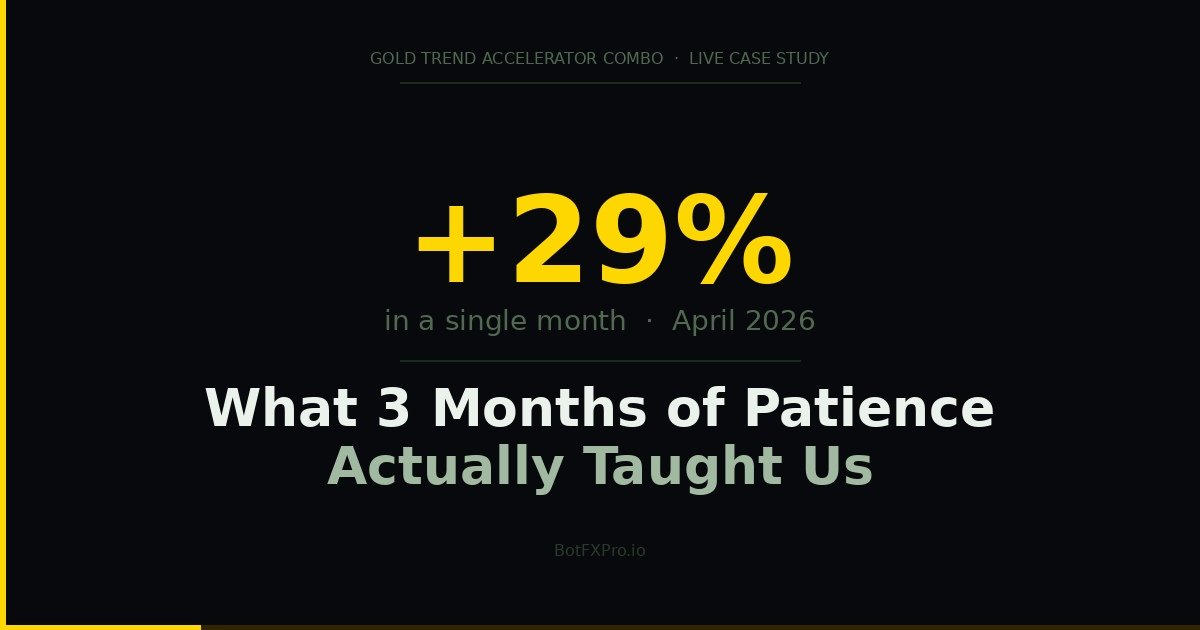
  • +29% in One Month: What 3 Months of Patience Actually Taught Us

    +29% in One Month: What 3 Months of Patience Actually Taught Us

    February 2026 came and went with almost nothing to show for it. -0.01%.

    March 2026 produced a small loss. -3.78%.

    If you had started running this EA in January and watched those two months pass, you might have started wondering — is it still working? Should I stop it? Did I choose the wrong system?

    April 2026 answered that question.

    April 2026
    +29%
    SINGLE MONTH
    3-Month Total
    +32.28%
    ABSOLUTE GAIN
    Max Drawdown
    16.81%
    ENTIRE PERIOD
    Live Profit
    $645.55
    FROM $2,000

    Every figure above is tracked and verified by a third-party platform connected directly to the live account. The account started with a $2,000 deposit in late January 2026 on a micro account.

    Why two “bad” months are not a warning sign

    Gold Trend Accelerator Combo runs seven independent systems simultaneously on a single XAUUSD chart. They split into two families:

    T-Systems (T1–T4) — Direct Trend
    Enter in the direction of the EMA crossover signal. Designed to capture sustained momentum in gold. Each system operates on its own timeframe — M30, H1, or H4 — with independently tuned EMA periods and ATR-based Stop Loss distances.
    R-Systems (R1–R3) — Counter Trend
    Enter opposite the EMA signal. Designed to profit from mean reversion. They perform well when gold overextends, reverses, or consolidates without breaking out cleanly.

    In February and March, gold moved without sustained direction. T-systems caught partial momentum moves but gave back gains when trends failed to extend. R-systems partially offset those losses — but the consolidation was not clean enough for strong reversal entries either.

    This is not system failure. This is the system waiting — absorbing an adverse period with contained drawdown rather than catastrophic loss.

    The monthly breakdown

    January
    +8.97%
    February
    -0.01%
    March
    -3.78%
    April ★
    +29%

    What April 2026 actually demonstrates

    April saw sustained directional movement in gold. The T-systems fired consistently into those conditions:

    • T3 on H1 — fixed TP structure locked in profits at predefined ATR-based targets as each momentum wave completed
    • T1 on M30 — trailing stop extended gains as intraday trends stretched further than expected
    • T4 on H4 — positioned into the larger structural move on the higher timeframe

    The R-systems were quieter in April — fewer counter-trend entries triggered. This is correct behaviour. In a trending market, the counter-trend systems reduce activity. Their silence in April is not underperformance — it is discipline.

    The result: +29% in a single month — not from excessive risk, but from T-systems firing efficiently into the conditions they were designed for.

    Three lessons from these three months

    Lesson 1 — Monthly results are the wrong lens
    February at -0.01% tells you nothing meaningful about system quality. It tells you the market was not cooperative that month. A good system survives the bad months and profits in the good ones — it does not profit every single month.
    Lesson 2 — Controlled drawdown is a feature, not a flaw
    -3.78% in March sounds unpleasant. Compare that to a martingale or grid EA in the same conditions — a bad month can mean -30% or a blown account. A system with a hard Stop Loss on every trade absorbs difficult months without destroying the account.
    Lesson 3 — Patience has a dollar value
    Anyone who stopped the EA in March missed +29% in April. One decision made from short-term anxiety can erase months of compounding in an instant. The system design only works if you give it time to work.

    How the system works — overview

    • Entry: EMA crossover, individually tuned per system and timeframe (M30, H1, H4)
    • Stop Loss & Take Profit: ATR-based — adjusts automatically to real market volatility
    • Trailing Stop: Selective — T1, T2, R3 use trailing stops; T3, T4, R1, R2 use fixed TP
    • Position sizing: One position per system max; lot size = % of account balance based on SL distance
    • Installation: Single XAUUSD chart — all 7 systems and 3 timeframes managed internally

    No grid. No martingale. Every trade carries a hard Stop Loss sent to the broker server at entry.

    Who this system is — and is not — designed for

    If you are looking for an EA that produces consistent gains every single month, this is probably not the right fit. Gold Trend Accelerator Combo is designed for traders who understand that real alpha often arrives in batches, who can accept a small controlled drawdown during unfavourable periods, and who think in multi-month terms.

    If you want a system with no grid, no martingale, a hard Stop Loss on every trade, multi-timeframe coverage from a single chart, and a verified live track record — this is worth a serious look.

    View Gold Trend Accelerator Combo →

    Past performance is not indicative of future results. Trading involves risk. Always test on a demo account before going live.