Why Most Martingale EAs Blow Up —
And What Actually Makes One Survive
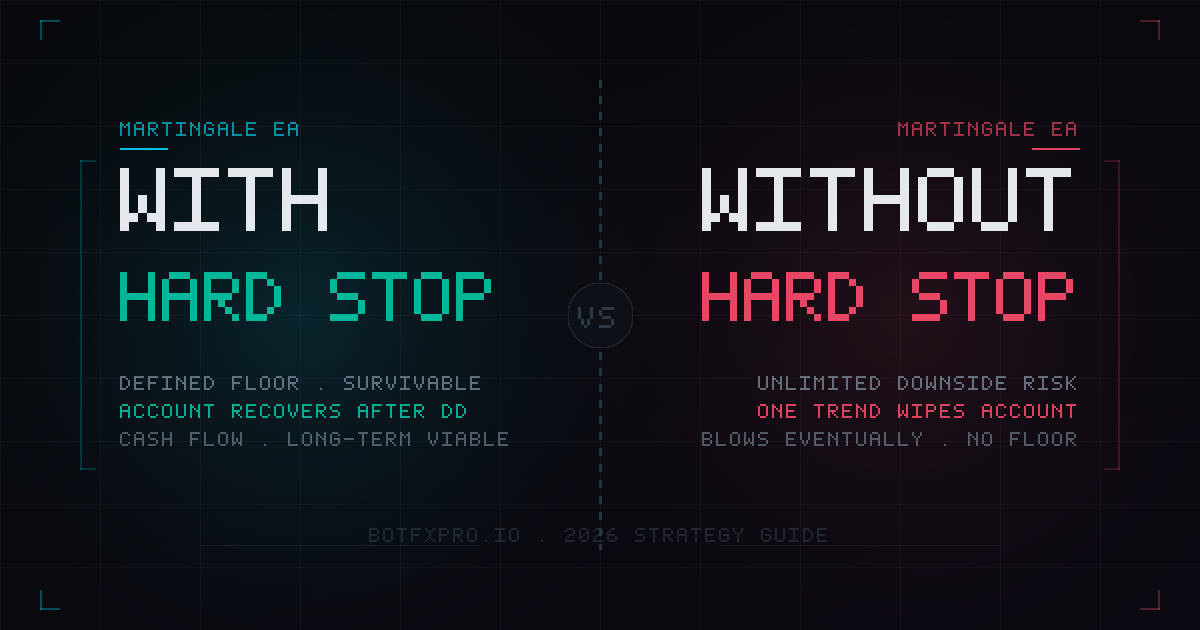
The math behind why standard martingale fails is simple: without a hard stop, one extended adverse run wipes everything. The strategy assumes the market must eventually reverse — but markets can trend far longer than your margin allows.
What’s less obvious is that the structural flaws in most martingale EAs go deeper than just “no stop loss.” After running a martingale-based EA on EURUSD H1 for over three years live and backtesting across 13+ years of data, here’s exactly what separates a system that survives from one that eventually doesn’t.
What a Surviving System Actually Does
NOT Pure Martingale — Adaptive Lot Multiplier
Classic martingale doubles immediately: order 1 at 0.01, order 2 at 0.02, order 3 at 0.04. Exposure compounds fast. The second order in a structured recovery sequence, by contrast, opens at the same lot size as the first — not doubled. Only as more orders accumulate does the multiplier gradually increase.
More importantly, if open recovery orders exceed a threshold, the system automatically reduces the multiplier. This is the opposite of what classic martingale does at exactly the wrong moment. The exposure curve flattens instead of accelerating.
The practical difference is significant. In a 5-order worst-case sequence, classic martingale has accumulated 16× the initial lot size by order 5. The adaptive approach reaches only 8× by order 5, then scales gradually to 12×, 18×, and 27× for orders 6–8 — versus classic martingale which would reach 32×, 64×, 128×. Same number of recovery orders: dramatically different peak exposure per order.
Every Entry Has a Real Edge — Not Random Grid Spacing
Most martingale systems place recovery orders at fixed pip intervals regardless of what price is doing — 20 pips down, 40 pips down, 60 pips down — with no reference to market structure whatsoever.
A properly structured system applies the same entry logic to recovery orders as to initial orders. Each position in a recovery sequence is filtered against market conditions to identify higher-probability reversal zones rather than arbitrary price levels. The result: fewer orders needed per cycle, better average entry prices, and faster recovery.
Exposure Per Cycle Is Hard-Capped
If a system can open unlimited orders in a single recovery sequence, it will eventually meet market conditions that exhaust your capital before it exhausts the losing streak. The question isn’t whether this happens — it’s when.
A hard cap on orders per cycle changes the risk profile fundamentally. The worst-case scenario is calculable before you deploy real money. You can answer the question: “If every recovery order in this cycle closes at a loss, what is my maximum drawdown?” — and get an actual number, not a range that extends to account wipeout.
| Feature | Standard Martingale | Hard-Capped System |
|---|---|---|
| Max orders per cycle | Unlimited | Fixed (e.g., 8) |
| Worst-case calculable? | No | Yes — before live trading |
| Capital requirement | Undefined | Specific and plannable |
| Margin call risk | Inevitable over time | Bounded and manageable |
This one structural difference is what makes it possible to publish real drawdown numbers — no asterisk, no “results may vary up to account wipeout.” Position sizing is designed around a pre-calculated worst case, not wishful thinking about how bad things can get.
Portfolio-Level Kill Switch
This is the single most important structural feature, and the one most often absent from retail martingale EAs. A hard stop loss enforced at the portfolio level — not per trade, not per cycle, but across the entire account — that closes all positions and halts the EA when cumulative drawdown hits a defined threshold.
For Chronos Algo on EURUSD: that threshold is −65%. The EA has never come close to triggering it in 13+ years of backtesting or 3+ years live. But it exists, it’s enforced by code, and it converts an unlimited-risk strategy into a defined-risk strategy.
Most EA vendors omit this because it forces them to publish a real worst-case figure. Publishing that number feels like marketing suicide. In reality, it’s the opposite — it’s the only thing that makes the risk profile honest.
Two More Differences Nobody Talks About
The Backtest Trap — Why 10-Year Results Can Still Lie
Backtests are easy to fabricate — not through dishonesty, but through the mechanics of how they work. Martingale EAs are particularly susceptible because the parameters controlling recovery behavior (lot multiplier, grid distance, max orders) have enormous impact on results and are easy to over-optimize.
Run the same martingale EA with 20 different parameter sets, pick the one that looks best, and publish those results. You’ve found a set that happened to fit the past 10 years of data. You haven’t found a system that’s robust to the next 10.
The Chronos Algo backtest covers 2013–present, including the 2014–2015 EUR collapse, 2020 COVID volatility spike, and 2022 rate-shock trending conditions. The live account has been running since 2022 — independently verified via MQL5 Signals and Myfxbook — and the equity curve shape across those conditions matches the backtest profile. That match is what matters, not the peak return figure.
What Transparency Actually Looks Like in EA Marketing
Almost every EA listing leads with a return percentage. Some lead with “verified results.” Almost none lead with maximum drawdown, honest strategy labeling, or a clear explanation of how the system loses money.
The pattern is predictable: screenshot of equity curve → impressive return % → vague mentions of “smart” or “adaptive” logic → no discussion of downside. The user is expected to assume the system is low-risk because the presentation avoids discussing risk.
| What Most EAs Show | What You Should Demand |
|---|---|
| Return % only | Max drawdown — actual historical peak-to-trough |
| “Non-martingale” or “safe grid” | Explicit strategy labeling: martingale? grid? hedging? |
| Backtest screenshots only | Live account on Myfxbook or MQL5 Signals |
| 30–90 day live track record | Multi-year live results across different market regimes |
| No discussion of worst case | Hard stop defined, worst case calculable before you deposit |
Transparency isn’t a marketing angle — it’s what lets a serious trader make an informed decision. If a vendor can’t tell you the maximum historical drawdown, what happens when the worst recovery cycle occurs, or exactly how the system exits losing positions, that’s not a gap in the pitch deck — it’s a gap in the risk management.
Martingale isn’t inherently fatal. The strategies that fail aren’t failing because they use martingale — they’re failing because they stack unlimited exposure on top of no-edge entries with no emergency exit and optimistic backtests that hide the downside.
What survives: adaptive exposure that doesn’t compound at the worst moment, entry logic that creates real edge on every order, hard caps that make worst-case scenarios calculable, and a portfolio kill switch that converts unlimited risk into defined risk.
The live numbers for Chronos Algo on EURUSD H1: ≈32.9% max drawdown over 3+ years, hard stop at −65%, results independently verified. That’s not impressive on a return leaderboard. It’s honest — and that’s the point.
Chronos Algo — EURUSD H1
13+ years backtested. 3+ years live. Max drawdown ≈32.9%. Independently verified on MQL5 Signals and Myfxbook.
View Chronos Algo →
Live Signal ↗
Risk disclosure: Trading forex with automated systems involves significant risk of loss. Past performance, including backtested results, does not guarantee future results. Maximum drawdown of 32.9% observed in live trading. Hard portfolio stop at −65%. Only trade with capital you can afford to lose.