Tag: no martingale EA

  • Gold (XAUUSD) EA Strategy: Why Trend-Following Works Where Martingale Fails

    Pair-Specific Deep Dives · Series C, Part 3 · 8 min read

    Gold is the most discussed instrument in retail trading and one of the most misunderstood for algorithmic systems. Many traders assume that what works on currency pairs will work on gold. Usually it does not — and the reasons why tell you something important about how to choose the right strategy for each instrument.

    This article explains how gold behaves differently from forex pairs, why trend-following strategies fit it better than mean-reversion, and what timeframes work best for systematic gold trading.


    How Gold Differs from Currency Pairs

    Currency pairs are driven by interest rate differentials — the relative economic strength of two countries. They tend to oscillate within ranges when those differentials are stable, and trend when they diverge significantly.

    Gold is different. It is priced in USD but driven by a completely different set of factors:

    • Real interest rates — gold moves inversely with real yields (nominal rate minus inflation). When real rates fall, gold rises.
    • Safe haven demand — geopolitical uncertainty, banking crises, and systemic risk events push gold higher regardless of interest rate conditions.
    • Central bank buying — sovereign gold purchases have been a structural driver of demand since 2022, with record buying from emerging market central banks.
    • USD correlation — gold is priced in USD, so USD strength typically suppresses gold prices. But during risk-off events, both can rise simultaneously.

    The result: gold trends more persistently and over longer durations than most currency pairs. When gold decides to move, it often moves significantly — 100-300 pip daily ranges on XAUUSD are common, versus 50-100 pips on EURUSD.

    Why Mean-Reversion Struggles on Gold

    Martingale and grid systems rely on the assumption that price will revert to a mean after moving away from it. On EURUSD, this assumption holds reasonably well over H1 timeframes because the pair’s drivers — two central banks with similar mandates — create natural equilibrium.

    Gold does not have the same equilibrium dynamic. When gold begins a trend — driven by falling real rates, safe haven demand, or central bank accumulation — that trend can persist for months or years without meaningful retracement. A martingale system trying to average into a counter-trend position on gold during these periods will exhaust its order limit before the market turns.

    The 2020 rally from $1,450 to $2,075 over eight months, and the 2024-2025 rally from $1,800 to $3,000+, illustrate how far gold can trend without giving mean-reversion systems a recovery opportunity.

    Why Trend-Following Works on Gold H1/H4

    Trend-following strategies — those that identify directional momentum and trade in the direction of existing trends — are structurally well-suited to gold for the same reasons that mean-reversion is not.

    On H1 and H4 timeframes, gold’s trends produce clear, tradeable momentum with enough structure to filter false signals. The H1 chart balances signal quality (more signal than daily) with noise reduction (less noise than M15 or M30).

    Why Not M15 on Gold?

    Gold’s large pip movements and wider spreads make M15 strategies expensive to run. A 3-5 pip spread on XAUUSD versus 0.5 pips on EURUSD means each trade costs 6-10x more relative to the pip target. On H1 and H4, targets are larger and spread costs become a smaller percentage of the expected move.

    The Gold Trend Accelerator Approach

    Gold Trend Accelerator uses a non-martingale structure — each position is independent, with its own entry logic and exit levels. This is intentional.

    On a trending instrument like gold, the goal is to capture extended moves — not to recover from losses by adding positions against the trend. The EA trades with the trend, uses proper stop losses on each position, and takes profit when targets are reached.

    The key difference versus the martingale EAs in the lineup:

    Gold Trend Accelerator (Trend-Following)

    • Hard stop loss on every trade
    • No recovery averaging — each position stands alone
    • Lower win rate (typically 40-55%) but positive expectancy through reward-to-risk ratio
    • Performs best during sustained directional moves
    • Underperforms in ranging, choppy gold conditions

    Chronos Algo (Adaptive Martingale)

    • No individual stop loss per trade
    • Recovery averaging when price moves against
    • High win rate (85-95%) but occasional large drawdowns
    • Performs best during ranging, mean-reverting conditions
    • Struggles during sustained trends

    The two approaches are complementary. A portfolio containing both — a trend-follower on gold and an adaptive martingale on EURUSD — may produce more consistent combined returns than either alone, because their best conditions differ.

    Account Requirements for Gold EAs

    Gold has much larger pip values than currency pairs. One pip on XAUUSD is $0.10 per 0.01 lot — identical to EURUSD. But gold moves in much larger pip ranges, so the effective dollar movement per day is higher.

    For a trend-following gold EA with hard stops, the key sizing consideration is the stop loss distance. A 50-pip stop on gold with 0.01 lots is a $5 risk per trade — manageable. But gold often needs 80-150 pip stops to clear normal intraday noise, which increases required capital accordingly.


    Next in the Pair-Specific Deep Dives Series

    Part 4: M15 vs H1 Timeframes for Forex EAs — how timeframe choice affects signal quality, spread sensitivity, and the number of trades per month.

    Publishing May 23, 2026

    Try It on a Demo Account First

    All BotFXPro EAs include a free MQL5 demo. Run it in Strategy Tester before committing to live.

    Gold Trend Accelerator on MQL5 →
  • Best Gold EA for MT5 in 2026 — What to Look For (And What to Avoid)

    Best Gold EA for MT5 in 2026 — What to Look For (And What to Avoid)

    If you’ve spent any time searching for a Gold EA, you’ve probably noticed something: the market is full of systems promising 90% win rates, zero drawdown, and consistent monthly returns that sound too good to be true.

    Most of the time, they are.

    This guide breaks down what actually matters when evaluating a Gold (XAUUSD) Expert Advisor for MetaTrader 5 — and how to tell the difference between a system built to sell and one built to trade.

    Why Gold Is Different From Forex Pairs

    XAUUSD moves differently from currency pairs like EURUSD or USDCAD. Gold is driven by macro sentiment (inflation expectations, central bank policy, geopolitical risk), session volatility — the London/New York overlap creates sharp, fast moves — and thin overnight liquidity where gaps and slippage are more common than on major pairs.

    This means a Gold EA needs different logic than a standard forex robot. Strategies optimized for low-volatility currency pairs often fail on Gold because the price action is faster and less predictable.

    The Biggest Red Flag: No Stop Loss

    The most common way Gold EAs manufacture impressive-looking track records is by running without a hard stop loss. Instead, they use martingale or grid strategies to “recover” losing positions by adding more trades in the same direction.

    This produces a beautiful equity curve — until the market makes a sustained move against the strategy. At that point, the entire account can be wiped in a single session.

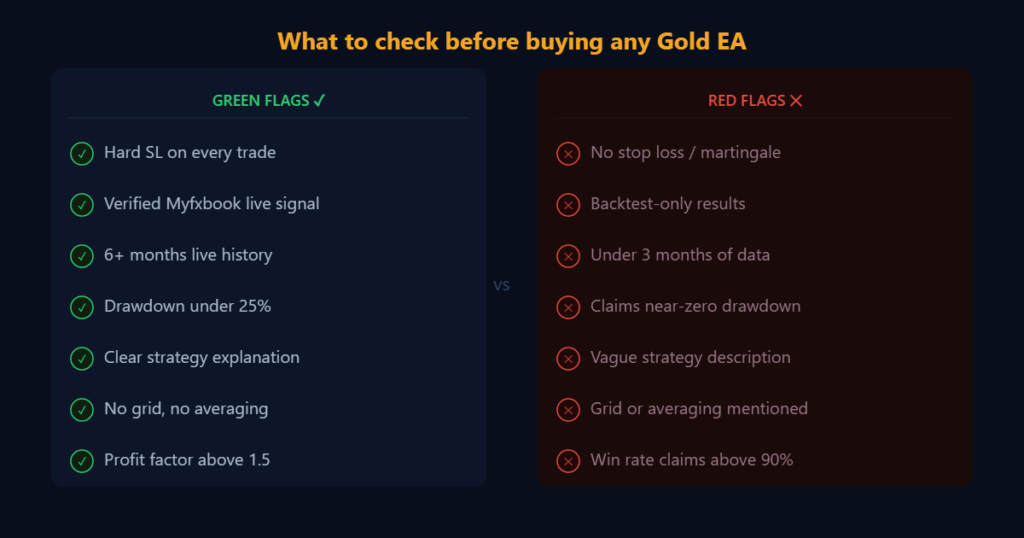
    How to spot it: Look at the trade history on Myfxbook or MyFXbook Signal. If every trade shows a stop loss of 0 or blank, the system has no exit plan for losing trades. That’s not a trading strategy — it’s a ticking clock.

    What a Legitimate Gold EA Track Record Looks Like

    A trustworthy Gold EA should have a verified live account (not demo) running for at least 6–12 months, hard stop losses on every single trade, a profit factor above 1.3, and a maximum drawdown under 25%.

    Win rate alone tells you nothing. A system can have a 95% win rate and still blow — because the 5% of losing trades have no stop loss and eventually crater the account.

    XAUUSD-Specific Settings That Matter

    When evaluating or configuring a Gold EA, these parameters matter most:

    • Spread filter — Gold spreads widen sharply during news events and session transitions. A good EA should skip trades when spread exceeds a defined threshold (typically 30–50 points on a 5-digit broker).
    • Session filter — Most profitable Gold moves happen during the London and New York overlap (1:00–5:00 PM GMT). An EA that trades 24/7 on Gold is likely taking unnecessary risk during low-liquidity Asian hours.
    • Lot sizing — Fixed lot vs. percentage-of-balance risk. For live accounts, risk per trade should be 1–2% of balance maximum.
    • News filter — High-impact news (NFP, FOMC, CPI) can move Gold 200–300 pips in minutes. A quality EA pauses trading around these events.

    How to Verify Before You Buy

    Before purchasing any Gold EA, do these three things:

    1. Check for a verified live account. Demo results are worthless — anyone can optimize a strategy to perform perfectly on demo. Look for a Myfxbook or FX Blue verified live account with real money at stake.

    2. Download the trade history. Export the full trade list and check the Stop Loss column on every trade. If it’s consistently blank or zero, walk away.

    3. Ask the vendor directly. “Does this EA use a hard stop loss on every trade?” A legitimate vendor will say yes without hesitation. Evasive answers are a red flag.

    The Bottom Line

    The Gold EA market is full of systems designed to look good in screenshots rather than perform consistently over time. The best Gold EAs aren’t the ones with the highest win rates — they’re the ones that are still running two years from now.

    Look for transparency: verified live results, hard stop losses, and a vendor willing to answer direct questions. That narrows the field considerably.


    Gold Trend Accelerator Combo from BotFXPro trades XAUUSD with 7 independent systems — 4 direct-trend and 3 counter-trend — all using hard Stop Losses on every trade. No grid. No martingale. View Gold Trend Accelerator Combo →

  • Why Most Forex EAs Fail(And How to Find One That Doesn’t)

    Why Most Forex EAs Fail(And How to Find One That Doesn’t)

    The statistics on forex EA failure are not encouraging. Most automated trading systems stop working within 12–18 months of release. Many blow accounts within weeks of going live.

    But some systems run for years, generate real profits, and survive multiple market cycles.

    The difference usually comes down to one thing: how losses are handled.


    The Core Problem: Manufacturing a Good Track Record

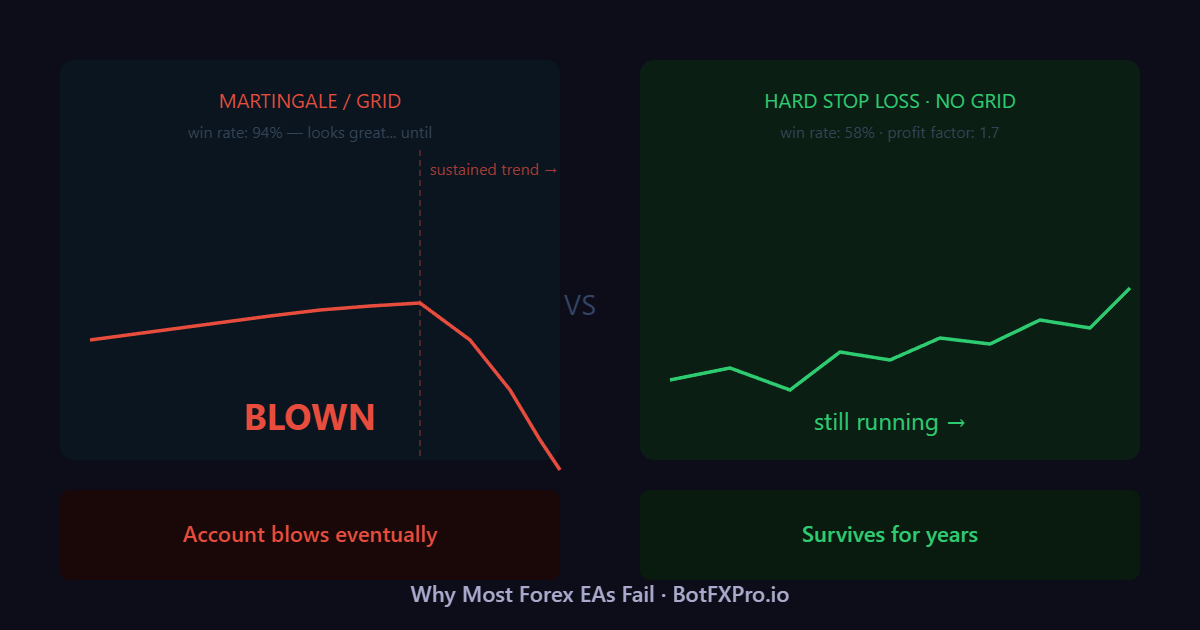
    The easiest way to build a forex robot with an impressive-looking track record is to remove the stop loss.

    Without a stop loss, a losing trade is never closed. Instead, it sits open — accumulating loss — while the equity curve shows a smooth upward line from closed trades. When you look at the stats, all you see are the winning positions.

    This approach has many names: martingale, grid trading, averaging down, hedging with correlated positions. The mechanics differ, but the principle is the same: losses are hidden, not managed.

    It works until it doesn’t. A sustained trend against the open positions triggers a margin call, and the account is gone.


    Why Martingale Feels Safe (Until It Isn’t)

    Martingale strategies add to losing positions. If you’re down on a trade, you open another in the same direction with a larger size. If the market reverses, the combined position closes at breakeven or better.

    In a ranging market, this can work for a long time. Win rates above 90% are common because most small reversals get recovered before closing at a loss.

    The problem is that trend markets — especially in currency pairs or gold — can move in one direction for weeks. At that point, martingale systems don’t recover. They compound the loss with each new addition until the account is exhausted.

    The win rate looks great right up until the account blows.


    What “No Martingale, No Grid” Actually Means

    A forex EA that uses no martingale and no grid has a fundamentally different risk profile:

    • Every trade has a hard stop loss — if the trade goes wrong, the loss is fixed and finite
    • Position sizing is independent per trade — a loss on one trade doesn’t affect the size of the next
    • Drawdown is bounded — the worst case is a series of losses at the defined risk per trade, not an exponential blowup

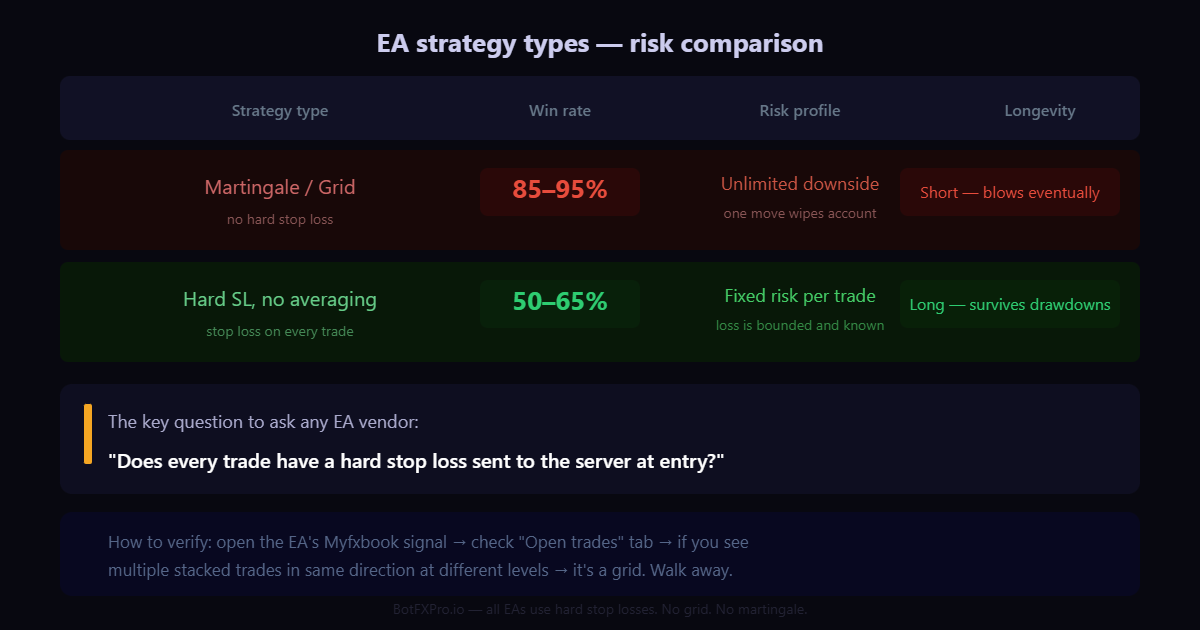
    The tradeoff is that win rates tend to be lower — typically 50–65% rather than 85–95%. But a 60% win rate with a 1.5:1 reward/risk ratio is sustainably profitable. A 95% win rate with unlimited downside is not.


    How to Verify a System’s Risk Approach

    Before purchasing any EA, check these specific things:

    1. Check the open trades section on Myfxbook

    If the live signal shows multiple open trades stacked in the same direction at different price levels, it’s a grid or averaging system — regardless of what the marketing says.

    2. Look at the maximum drawdown

    A martingale system will show a very low drawdown until it blows. But if you look at the floating drawdown on open trades, you’ll often see large unrealized losses.

    3. Ask directly

    Email the vendor and ask: “Does every trade have a hard stop loss sent to the server at the time of entry?” A legitimate vendor will say yes. An evasive answer is a red flag.

    4. Check the trade history

    Download the full trade history from Myfxbook and look for the stop loss value on every trade. If it’s blank or zero, the system has no hard stop.


    The Long-Term Advantage of Hard Stop Losses

    Systems that use hard stop losses have one major structural advantage: they survive.

    A martingale system that runs for 2 years might look better than a hard-stop system over the same period. But the martingale system carries the risk of a single catastrophic event that destroys everything. The hard-stop system takes smaller, defined losses and continues operating.

    Over a 5–10 year horizon, the compounding effect of a consistently profitable, risk-managed system significantly outperforms a high-win-rate system that blows once every few years.

    This is why institutional traders don’t use martingale. Position limits, risk per trade, and hard stops are standard practice — not because they maximize short-term performance, but because they preserve capital for the long run.


    EA strategy types — risk comparison

    What to Look For

    Strategy TypeWin RateRisk ProfileLongevity
    Martingale / Grid85–95%Unbounded lossShort (blows eventually)
    Hard SL, no averaging50–65%Fixed risk per tradeLong (survives drawdowns)

    When you find an EA with a multi-year live track record, hard stop losses on every trade, and no grid or martingale — that’s the rare system worth your attention.


    Looking for an EA with hard stop losses, no grid, and no martingale on every trade? The Gold Trend Accelerator Combo runs 7 independent strategies on XAUUSD — each with a hard SL, zero averaging, and zero grid logic. Learn more →