Education · Risk Management · 10 min read
Most traders who blow up their accounts do not lose because their strategy is bad. They lose because their position sizes are wrong. One trade too big, one stop too wide, one missed calculation on a non-standard instrument — and months of gains disappear in an afternoon.
The good news: position sizing is math, not magic. Once you understand the formula and the three numbers that feed it, you can size any trade on any instrument correctly, every single time. This guide walks through it from first principles.
What You Will Learn
The one formula that works for every instrument, how to calculate each input, why gold and indices break naive lot calculators, and how to get the math right in under 5 seconds per trade.
The Universal Position Sizing Formula
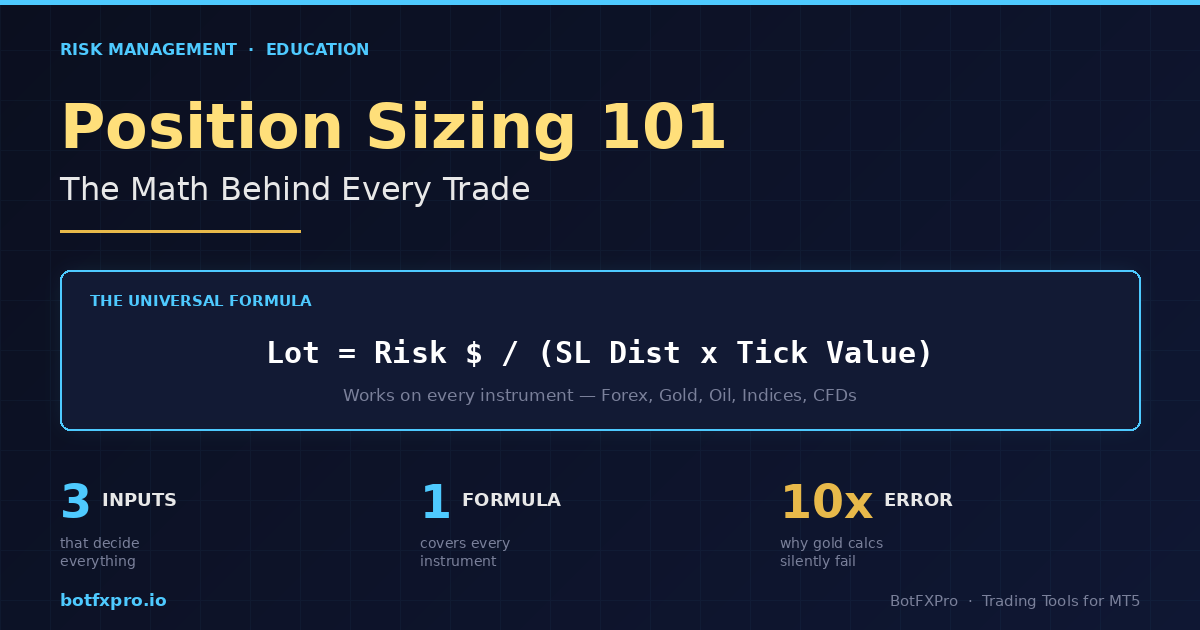
Every correct lot size calculation reduces to a single equation. No matter what you trade — Forex, gold, oil, indices, crypto — the formula does not change:
Lot Size = Risk $ ÷ (SL Distance × Value Per Point Per Lot)
Three inputs. That is it. If you know how many dollars you are willing to lose on this trade, how far your stop loss sits from your entry, and how much money each point of price movement costs you on one lot — you have the answer.
The reason traders mess this up is not the formula. It is getting those three inputs right, especially the third one. Let us break each of them down.
Input 1 — Your Risk Amount in Dollars
This is the easiest one. Pick your risk percentage, multiply by your account balance.
If your balance is $10,000 and you risk 1% per trade, your risk amount is $100. That is the maximum dollar loss you will accept if this trade hits your stop loss.
How much should the percentage be? Most professional traders and prop firm rules sit somewhere between 0.5% and 2% per trade. Below that and winners barely move your account. Above that and a normal losing streak wipes you out.
Quick Reference
A string of 5 consecutive losses at 1% risk drops your account 4.9%. The same 5 losses at 5% risk drops it 22.6%. This is why small percentages matter.
Input 2 — Stop Loss Distance
This is the distance between your entry price and your stop loss price, measured in the instrument’s smallest unit of movement. On EURUSD, that unit is typically a pip. On XAUUSD (gold), it is usually $0.01 or $0.10 depending on broker. On US30, it is 1 index point.
The critical thing: your stop loss distance is determined by your chart analysis, not by what lot size you want to trade. If the correct technical stop is 50 pips away, that is your stop — you do not tighten it to 10 pips just to trade bigger. Tight arbitrary stops are a direct path to account death.
Worked example on EURUSD:
- Entry: 1.0850
- Stop loss: 1.0820 (just below a swing low)
- Distance: 30 pips
Input 3 — Value Per Point Per Lot (The One People Get Wrong)
This is where naive lot calculators — and a lot of traders — go completely off the rails. The value per point depends on the instrument, and it is not the same across your watchlist.
For standard Forex pairs, the math is familiar:
- 1 standard lot = 100,000 units of the base currency
- On EURUSD, 1 pip on 1 standard lot ≈ $10
- On GBPUSD, same — ≈ $10 per pip per standard lot
- On USDJPY, close to $10 but varies with the USDJPY rate itself
Plug those numbers into our formula with the EURUSD example:
Risk $: $100
SL distance: 30 pips
Value per pip per lot: $10
Lot = 100 ÷ (30 × 10) = 0.33 lots
So a correct 1%-risk trade on a 30-pip stop at $10,000 balance is 0.33 lots. Not 1 lot. Not 0.1 lots. The math is precise.
Why Gold, Indices, and Oil Break Naive Calculators
This is the part that trips up traders — and where most free online lot calculators fail silently.
On XAUUSD (gold), a “pip” is not well-defined. Different brokers quote gold with 2, 3, or even 4 decimal places. The contract size also varies — some brokers use 100 oz per lot, others use 10 oz. If you assume $10 per “pip” like on EURUSD, your risk calculation could be off by 10x.
On US30 or NAS100 CFDs, one index point might be worth $1 per lot on one broker and $0.10 on another. Oil (Brent, WTI) is similar — contract sizes and tick values are broker-specific.
The fix: stop thinking in pips for these instruments. Use Tick Size and Tick Value — two values your broker publishes for every instrument, and that MT5 exposes directly:
- Tick Size — the smallest price increment (e.g. 0.01 for gold, 1.0 for US30)
- Tick Value — the dollar value of one tick on one standard lot (e.g. $1 on gold at 100 oz lot size)
The universal formula rewritten in these terms:
Lot = Risk $ ÷ ((SL distance ÷ Tick Size) × Tick Value)
This works for everything. Gold, oil, crypto CFDs, DXY, US30, Bitcoin — every instrument has a published Tick Size and Tick Value, so you just plug them in.
Common Mistake
Using a “gold pip calculator” from a website that assumes $1 per pip per mini lot. On a broker that uses 10-oz contracts with 2-decimal pricing, this can under-size your position by 10x — meaning your “1% risk” trade is actually risking 0.1%. The opposite error (over-sizing by 10x) blows accounts in a single trade.
Worked Example on Gold
Suppose your broker quotes XAUUSD with 2 decimal places (tick size 0.01), 100-oz contracts, and a tick value of $1 per tick per standard lot. You want to buy gold at 2650.00 with a stop at 2645.00 — a 5-dollar move, which is 500 ticks.
Balance: $10,000 · Risk 1% → Risk $ = $100
SL distance: 5.00 ÷ 0.01 = 500 ticks
Tick value per lot: $1
Lot = 100 ÷ (500 × 1) = 0.20 lots
0.20 lots of gold at a 500-tick stop risks exactly $100. Every time.
Sanity Checks Every Trader Should Run
Before you click BUY or SELL, run these three quick checks:
- Is the risk dollar amount right? If your 1% risk shows as $1,000 when your account is $10k, something is off by 10x.
- Is the margin required reasonable? A calculated lot that requires more margin than your free margin means the position will be rejected — you need to either lower risk % or take a tighter stop.
- Does the lot round to the broker’s minimum step? If the formula says 0.347 lots but the broker only accepts 0.01 increments, round down to 0.34 — never up.
The Shortcut — Automate the Math
Doing this calculation by hand before every trade is slow and error-prone. When markets move fast, you skip the math — and that is exactly when wrong lot sizes get entered.
The solution is to let MT5 itself handle the calculation. Every instrument in MT5 exposes its Tick Size and Tick Value through the broker’s symbol specification, so a well-written EA can read those values directly and output the correct lot size in real time — no guesswork, no broker-specific table lookups, no pip-vs-tick confusion.
This is exactly what RiskFlow Pro does. You enter your risk %, your entry, and your stop — it reads the instrument’s real Tick Size and Tick Value from your broker and gives you the correct lot size instantly. Works on Forex, gold, oil, indices, crypto CFDs, whatever your broker offers.
If you are new to the tool, the Quick Start guide walks you from download to your first properly-sized trade in under 5 minutes. It is free on MQL5 and works on any broker account.
Practical Tip
Even if you use an automated calculator, do the manual math on paper for the first 5 trades of any new instrument. This builds intuition for what “correct” looks like and helps you spot calculator errors before they hurt you.
Key Takeaways
- Position size is math, not opinion. One formula covers every instrument.
- For Forex pairs, pip value thinking works. For gold, indices, oil, and CFDs, use Tick Size and Tick Value instead.
- Your stop distance comes from chart analysis, not from what lot size feels good. Size the position to fit the stop — never the reverse.
- Automating the math removes the single most common cause of retail blowups: wrong lot size on non-standard instruments.
Get RiskFlow Pro
Stop calculating lot size by hand.
Free MT5 dashboard that does the math for you — on any instrument, any broker.
Or read the Quick Start Guide first — you will be trading properly-sized positions in under 5 minutes.
Leave a Reply